word research on cut knife grid road map
Archives, Museum

About Broncos & Western Horses

A RESEARCH REQUEST

Research requests are always varied and interesting, and it’s easy to get lost in the stories from decades ago. Just before Christmas, the Museum received a request for any information regarding Dan Munsell and the western horses he sold out east in the mid-1940’s.

THE FACTS

Dan Munsell had sold a carload of western horses to the lumbermen and farmers of the Sussex, NB area. [The researcher’s grandfather] had bought a team of horses from them. During this horse purchasing transaction, [the researcher’s father] was able to get to know Mr. Munsell and his stepson. 

After all the carload of horses were sold, Mr. Dan Munsell bought a second-hand car from a car dealer in St. John, NB. The car was a used 1940’s dark green 4 door Chevrolet, which had a standard transmission, whose previous owner was a doctor in St. John. 

In early May 1946, [the researcher’s 19 year-old father] and his high school buddy Ernie started their fascinating journey west. They drove from Sussex, New Brunswick to Cut Knife, Saskatchewan with Dan Munsell and his stepson.

– from the request

FROM A LOCAL HISTORY BOOK

The researcher had numerous questions about the horses, their transportation out east, and other details. Unfortunately, very little information turned up in the Museum’s search. The following excerpt was the only direct reference:

When farming was horse power, the Munsell family were involved in securing and breaking bronchos. This meant they would go down to Medicine Hat, Alta. and drive back a number of head of range bronchos and then commence the work of breaking the animals to harness and work. When broken these were sold to other farmers in the area. This also meant that the problem of getting the animals to Cut Knife meant overland drives of many miles and several days duration.

from Blended Heritage: Zera Albert and Mary Ellen Munsell family history, page 773.

FROM A PRIMARY SOURCE

So Randy S. went looking further afield and offered up the following notes from Glen Brebner, a lifelong horse aficionado:

The horses referenced as broncos in the text were likely feral horses from the Alberta foothills. They were smaller, tougher, and stronger, and were captured, broke, and sold for work in those days. They were sometimes called cayuses or broomtails because of their long bushy tails which they’d turn to the wind to protect themselves from the cold in the winter and which would swish flies in the summer.

Glen says that sometimes people would try to “improve” these horses by culling out their natural stallions and substituting draught horse stallions to try to increase the size. The curious thing is that the interbreeding would only take for one generation, then the horses would always revert to their smaller ancestors. They were often sold for work around Saskatchewan and transported to the east coast by rail car.

from a conversation between Glen Brebner and Randy S.

So many stories, so little time…

~ Debbie M.

ww1 battlefield
Archives

Remember Private Ernest Robinson?

During SCAA Archives Week 2023, we shared a request for information that we’d received from a museum in Belgium.

The CMMM Archives received a request for information from the Memorial Museum Passchendaele 1917 in Belgium. Their researchers have been able to identify the wartime burial locations of more than 1,400 of the 6,928 missing Canadians in Flanders. One of the burial sites located has been identified as belonging to Ernest Robinson, who homesteaded in the Cut Knife area. His name is listed on the Roll of Honour in our local history book Where the Cut Knife Waters Flow Volume I.

from: In Memory of Private Robinson, Feb. 6, 2023

The Passchendaele Museum wanted the Robinson family’s descendants to know his burial site had been determined. His last known next-of-kin had resided in Tatsfield, Saskatchewan, which the museum was unable to trace to a modern address. The next step was to contact the CMMM regarding Names in the Landscape, their digital exhibit sharing the lives of the Canadian soldiers lost in Flanders. They asked for photos of, or archival references to Ernest Robinson that would help tell the story of his life.

We asked our readers for any photos and / or memories they might have of Private Ernest Robinson that we could forward to the Passchendaele Museum. Not only did we receive excerpts from a number of local history books, but through the power of social media, we were able to reach a family member. Since then, the Robinson family has put together a submission for the Names in the Landscape online exhibit.

Pte. Robinson’s nephew, Ken Robinson and Ken’s cousin Holly Robinson have researched and written a short biography of Private Ernest Robinson. It is an honourable tribute to someone whose life was cut so short. It includes a timeline and description (with references) of his military life. They have kindly shared the link with us.

Remember Private Ernest Robinson. Read more here.

~ Debbie M.

where the cut knife waters flow, book cover edited
Archives, Our Stories

The Gold Mine for Family Historians

An ever-increasing number of people are taking a deep-dive into their family histories: constructing their family trees and searching out the stories that give their ancestors’ lives context. Archives are the building blocks for these projects; they are the treasure troves containing the chests of gold.

The Family Tree is mapped out through the use of vital statistics. Birth records, death certificates, enlistment papers, ship’s manifests, baptism certificates, obituaries, etc. are used to identify an individual’s ancestors. Secondly, stories from newspapers, local and oral histories, archival records, etc. are used to place people within the context of their times. 

Clayton McLain Memorial Museum | Family Histories

Today, so much of the information necessary to fill-in-the-blanks of a family tree or to discover the context of a life once-lived is available online. Archives, large and small, are digitizing historical records, putting the files online, even providing forms to request copies of particular documents. For SK Archives Week 2015, the CMMM introduced three Genealogy Resource pages on our website, which were updated in late 2021, and combined to form the current Genealogy Links page.

Additional archival resources can be found at:

  • Saskatchewan Historical Newspapers Online (SHNO) project which includes the Cut Knife Journal and the Cut Knife Grinder. Some early copies have suffered damage, others have pages missing but they are always worth a look. (Click to view.)
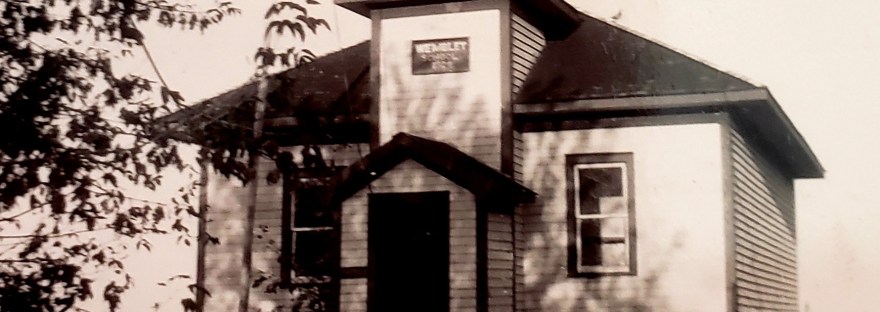
  • Local Histories (i.e. Where the Cut Knife Waters Flow Volumes I and II) are difficult to come by. Most are out-of-print, although the odd one may occasionally pop up for sale but often, at quite a price. Some can be found at local museums and archives, and some, the lucky few, can be found in digital collections. For example, Time Marches On : a history of the Alfred, Formby, Wardenville and Wembley School Districts is available to read online at the University of Calgary’s Digital Collections Library. Finding a digital version of a local history relevant to your research is another gold mine.

Back in the day, a researcher would often have to travel to individual archives to access their materials. Now, a huge array of resources, from around the world, have a home online. Visit CMMM’s Genealogy Links to be amazed…

~ Debbie M.

Wembly School
Archives, Our Stories

Research is a Treasure Hunt

It’s true. Researching online is not as satisfying as sitting in an archives, gloves on, examining primary source materials in person. The advantage, however, is that plugging in combinations of search terms on a search engine of choice, can be done at home, at a researcher’s convenience. The results vary, of course, depending on subject matter, etc. but as more collections are digitized and uploaded online, the rewards improve.

To date, the Clayton McLain Memorial Museum has three online exhibits:

  • Cut Knife Town Centre exhibit was highlighted in yesterday’s post. (Click to view.)
  • Attons LakeA Summer Meeting Place was developed as a Canadian Heritage Information Network (CHIN) Community Memories Project. The slideshow consists of 216 photos with accompanying text, and an additional 2 dozen stories. (Click to view.)
  • Cut Knife and Districts School Sites & Points of Interest is presented as a pdf document. The information was compiled in time for the 2012 Town of Cut Knife Anniversary and is complete with school districts noted and GPS coordinates provided. Perfect for a Sunday drive. (Click to view.)

All of the online exhibits and projects mentioned over the past few days rely on archival research which, in the case of a volunteer-run museum and archives, is dependent upon – yes – volunteers. Specialized knowledge is not required. Often, the search is for something quite specific, and it can be fun. It’s almost like looking for buried treasure with so many interesting tidbits discovered along the way.

We haven’t identified our next project yet, but if you’d like to be a part of a research team, it only takes a word with Lucille or a Board member, or an email to cmmmcutknife@gmail.com. We look forward to working with you!

~ Debbie M.

113 broad street in 1914
Archives, Our Stories

Throwback Thursday to 2012

2012 was the year the Town of Cut Knife turned 100 years old. The anniversary was celebrated on Canada Day long weekend with a full slate of community events. The planning and preparations had been ongoing for many months and the Clayton McLain Memorial Museum and Archives had been involved with a number of them.

cut knife centennial mural
Located on the south side of Country Lanes, 201 Broad Street

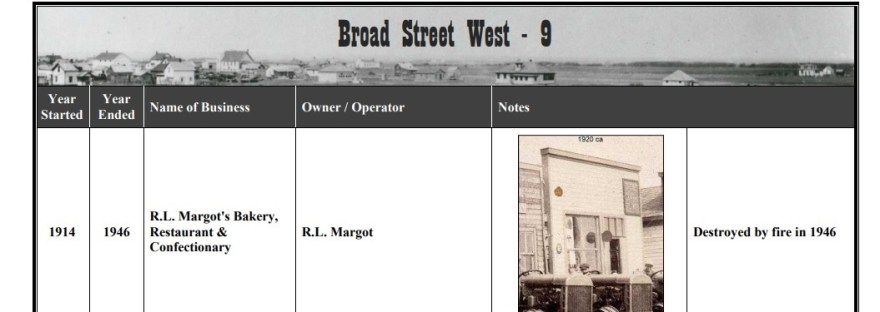
The mural to commemorate the founding of the town was based upon a selection of archival photos that represented key events and people in the town’s development. The Cut Knife Town Centre exhibit was completed with a committee of volunteers who researched the successive ownership of downtown business lots. Their findings were displayed on outdoor signage adjacent to the lots during the summer of 2012. For SK Archives Week 2015, the Cut Knife Town Centre exhibit was digitized for the CMMM website.

¬ Debbie M.