The Duvall House was built in 1928. It was moved from the farm to the Museum site prior to the Town of Cut Knife’s Centennial in 2012. The house needed some maintenance work and a few upgrades before it was ready for the public, and a fresh coat of paint was high on the list. The walls were filled and sanded; colours were selected to reflect the time period; the house interior was painted. Then came winter.
The upgrades did not include winter heating and the freeze / thaw cycle over the next few years were not kind to the paint. A number of different treatments were tried with varying degrees of success but still the paint peeled and flaked – until Terri suggested chalk paint. Chalk paint is a mixture of plaster-of-paris, warm water, and latex paint. It’s applied with a chalk brush and is worked into the existing wall plaster.
A test wall a few years ago proved to be very encouraging. So, this past Labour Day weekend, Terri and I set to scraping and painting the Duvall House front entrance. The results have been amazing! We’ll be checking it out closely next spring and if there’s no sign of deterioration, be prepared to see a call out for volunteer painters!
A few photos:
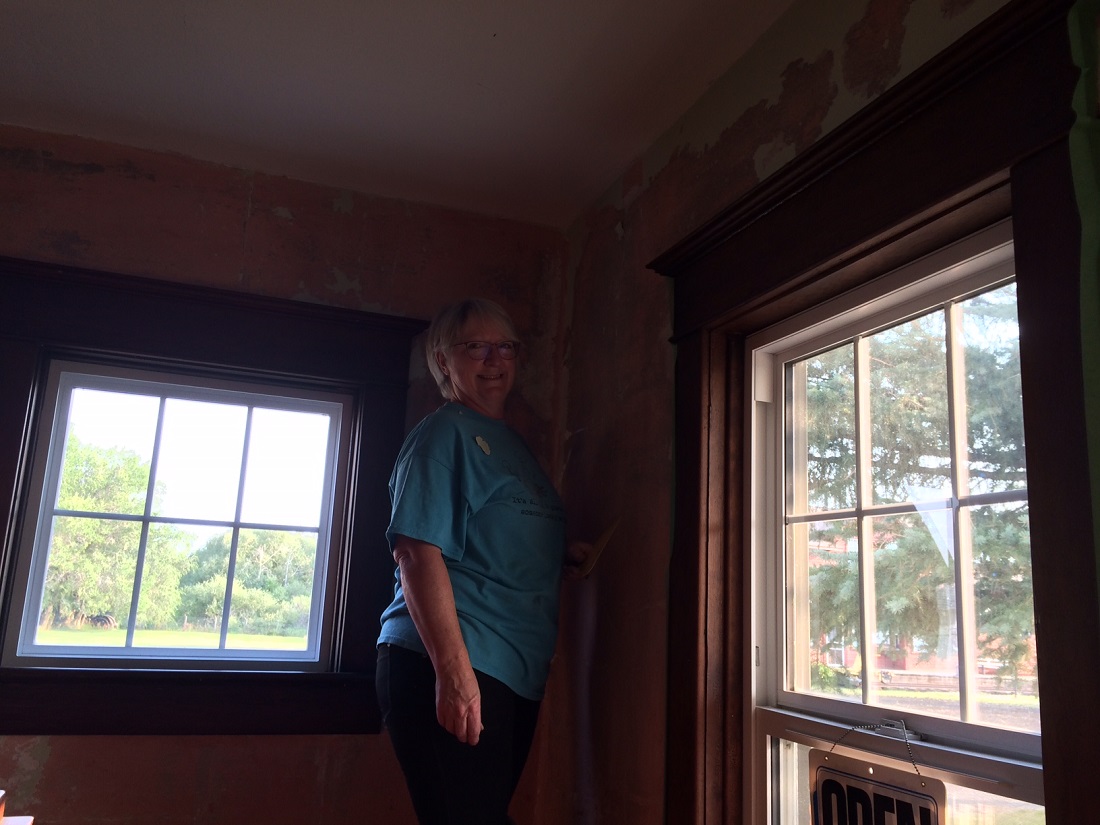
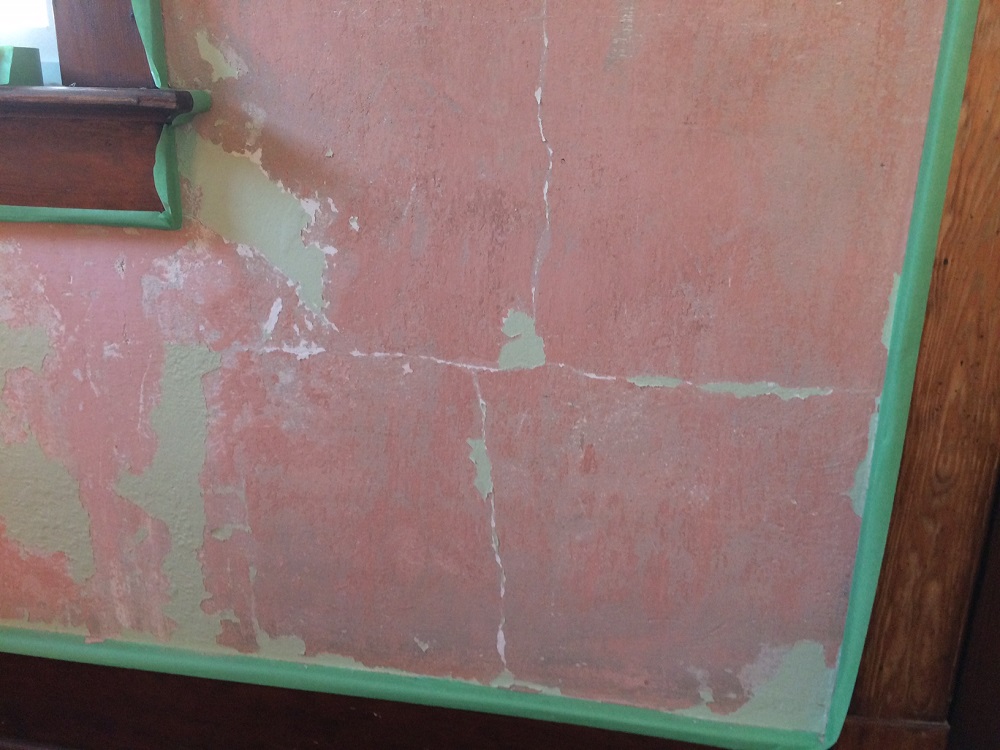
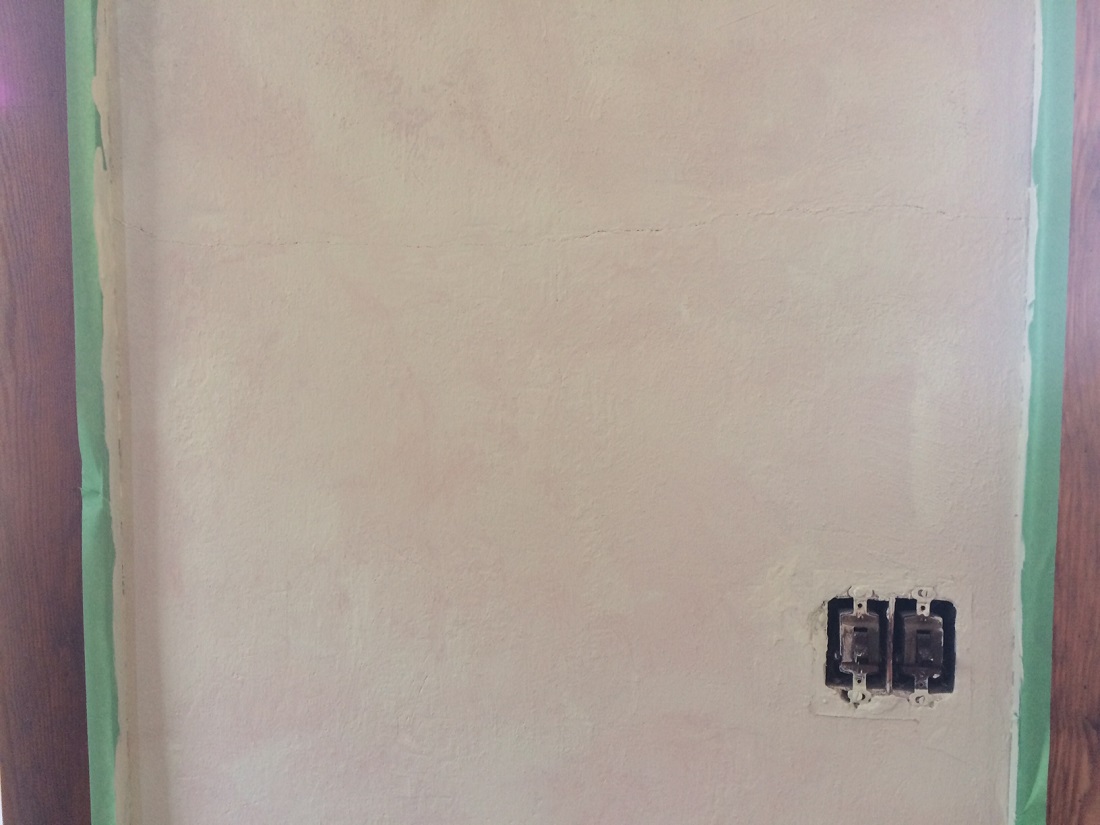
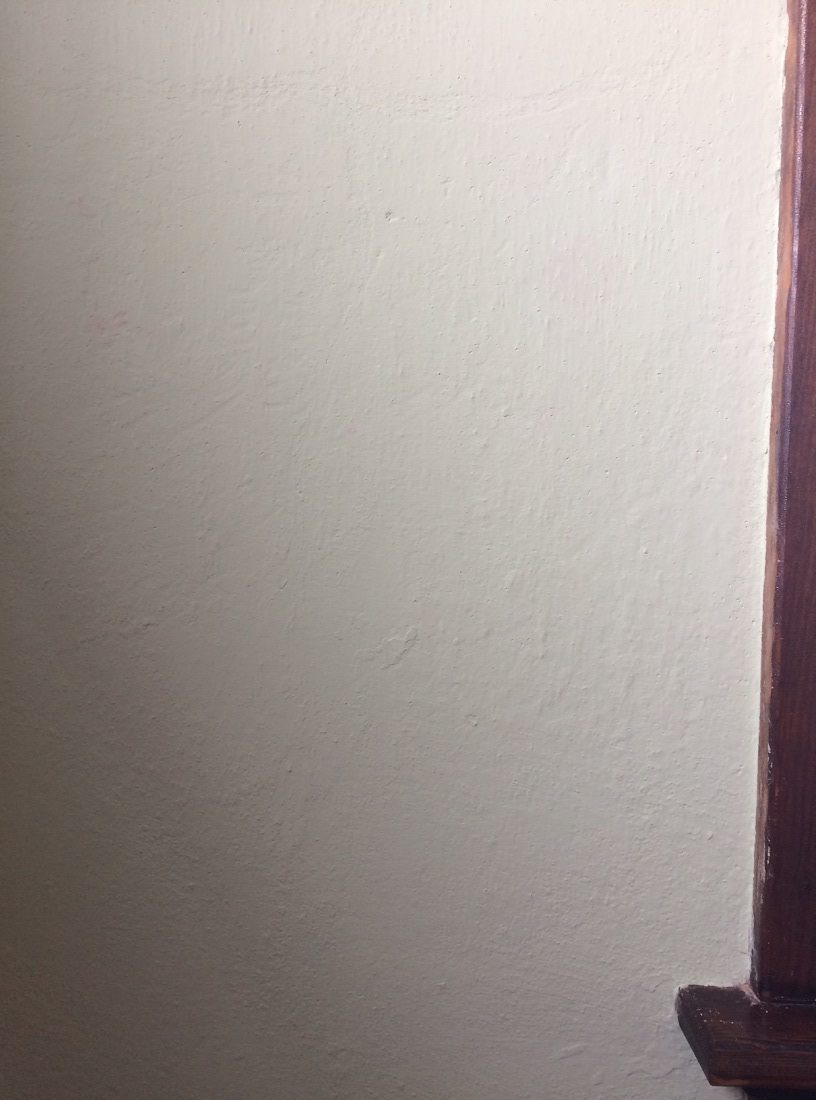
Flaking mint green paint removed exposing the previous rose colour.Terri preparing the paint. Note the two chalk brushes closest to the brown jars.First coat of mint green over the previous paint.Second coat of mint green paint even covers the wax crayon scribbles!Picture returned to the wall. Mission accomplished.
Angie has been working the summer seasons at the Clayton McLain Memorial Museum since 2016. She’s the Staff Supervisor, Tour Guide, Jack-of-all-Trades, and most importantly, Assistant Curator who catalogues as many artifacts as she can, each summer, in between all of the above tasks and responsibilities. We are extremely fortunate that she is happy to return to the museum year after year.
A few weeks ago, we were talking about visitors to the CMMM and their responses to the Heritage Village. Angie noted that one of the most frequent comments she hears is, “You’ve got EVERYTHING here!” And, Angie’s response is always, “Everything. Except one thing.” Of course, we all want to know what that one thing is, and Angie’s answer surprised me, too.
The answer is jeans. Not just any old jeans, though. Angie’s referring to an authentic pair of old bib overalls that have a direct connection to the area. She said, “just ask if anybody still has a pair of Grandpa’s old jeans tucked away somewhere.” Unfortunately, both Angie and I know it’s not quite that simple.
For anyone who has an item they’re considering giving / donating / passing along to the museum, the Acquisitions Committee follows a strict set of guidelines to determine if a particular item should be added to the CMMM collections.
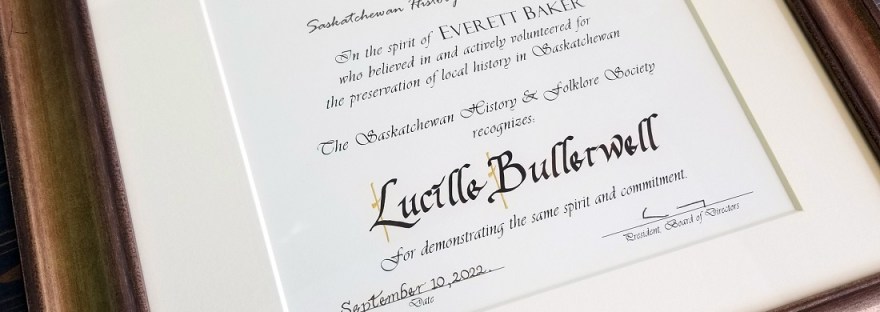
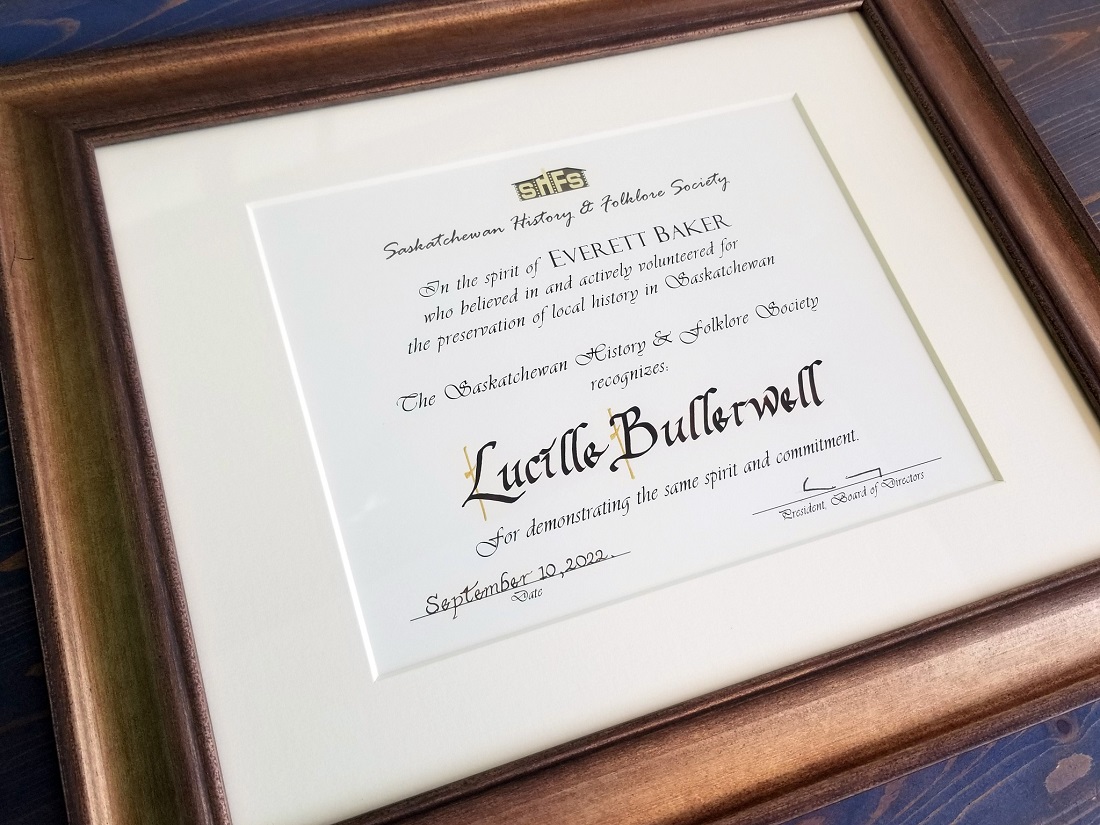
On Saturday, September 10, the Saskatchewan History and Folklore Society (SHFS) recognized Lucille Bullerwell’s longtime commitment to the Clayton McLain Memorial Museum by awarding her the 2022 Everett Baker Award for Saskatchewan Heritage.
2022 Everett Baker Award for Saskatchewan Heritage awarded to Lucille Bullerwell
Everett Baker, the SHFS’ first President, was a firm believer in promoting the past to build a better future, and worked tirelessly to preserve local history. In that spirit, the Baker Award recognizes individuals, groups, or organizations who have gone “above and beyond” to preserve and promote Saskatchewan heritage.
From the SHFS:
It is our very great pleasure to announce that the winner of the 2022 Everett Baker Award for Saskatchewan Heritage is Lucille Bullerwell!
Lucille has dedicated more than 25 years of her life to growing and maintaining the Clayton McLain Memorial Museum and Archives to preserve the history of the Cut Knife area.
After assisting Elizabeth McLain, the museum’s original Volunteer Curator, for approximately 8 years, Lucille took on the role of Volunteer Curator in 2003. Lucille held the position of Volunteer Curator from 2003 to 2013. At that time, she retired as Curator but stayed as a Board Trustee. In 2014, she left the Board and now continues to volunteer, oversee curatorial tasks, and mentor the CMMM’s seasonal Museum Manager (hired in 2016).
Lucille’s contributions to the success of the museum have been substantial. Her role included all aspects of collections management (development, storage, and preservation of artifacts and archival materials) and exhibit management (designing, budgeting, constructing, and staging exhibits).
She has ensured the preservation of the collections, displays, and exhibits by proactively developing policy and practices to incorporate and adhere to museum and archives industry standards. She established the CMMM Archives in 2009 under the guidance of the Saskatchewan Council of Archives and Archivists (SCAA), bringing all archival materials under one roof and one set of policies.
Lucille created a First Nations Elders Advisory Board to ensure proper care and handling of First Nations’ artifacts, and to facilitate the repatriation process of these artifacts, as requested.
She established the museum’s online presence with a website, expanded the website’s reach via social media, and made the website an online resource through digital exhibits. She has increased the museum’s exposure to new audiences through tourism initiatives, networking opportunities, and community partnerships.
Lucille’s long-time volunteer commitment to preserving and promoting heritage at the Clayton McLain Memorial Museum is truly “above and beyond.”
Lucille was honoured to receive the award. She insisted that “no one does this alone” and acknowledged all of the support, assistance and encouragement she’d received over the years from the Cut Knife community, the Town and R.M. of Cut Knife, CMMM staff and volunteers, Elder Advisors, Wendy Fitch and the Museum’s Association of Saskatchewan, and Sask Culture.
Lucille’s nomination package was submitted by the Clayton McLain Memorial Museum and Archives’ Board of Trustees.
In 1980, the East Cut Knife and Districts Historical Society published a local history book titled, “Where the Cut Knife Waters Flow”. It was a collection of submissions researched and compiled for Celebrate Saskatchewan 1980 and dedicated “to the memory of the pioneers who settled in the area.” Written by ordinary people who lived locally, the book gives us the stories of the area’s settlers in their own voices.
On July 17th, the Museum hosted a Quilt Walk, and for a few weeks afterwards, I posted photos / descriptions of the quilts on our blog. One post in particular caught the eye of someone born in Cut Knife, now living in B.C. Lorraine Martin brought it to our attention that The First Day of School Dress was not created by Mary Duvall, but by Mary (MacMillan) Rutley for her daughter Jessie Rutley Vance. Her proof was the family tree in her own book, Notes and Clippings, It All Started in Saskatchewan. We’re thankful the record has been corrected.
LOCAL HISTORIES IN THE GIFT SHOP
Notes and Clippings, It All Started in Saskatchewan by Lorraine Martin
My story starts with my early life in the Gallivan / Cut Knife area in the early 1940s and 1950s. It continues through my training as a Psychiatric Nurse at the North Battleford Provincial Hospital then after graduation my working years in England and Switzerland…
Lorraine Martin
Odds and Ends: Autobiography by Orval Ens
Contents include the following chapters: My Forebears; From 0 – 80; School Daze; My Teaching Career; From Horse and Buggy to Automobile; The Terrible Blizzard of December 1955; Breath of French Air…
Orval Ens
Prairie Christmas: A Collection of Stories and Recollections, A Clayton McLain Memorial Museum Project Cut Knife, Saskatchewan 2006 – 2007
This delightful compilation of Christmas stories was compiled by a group of volunteers to not only document history, but to be a fundraiser for the Clayton McLain Memorial Museum… We invited people to write stories about their Christmas memories…
The Prairie Christmas Committee
Where the Cut Knife Waters Flow Volume II
100 Years Celebrating Saskatchewan’s Centennial 1905 – 2005





 Clayton McLain Memorial Museum