prairie winter view
Archives, Our Stories

Tuesday is for Trails

Archival materials at the Clayton McLain Memorial Museum Archives range in time and type. Items include recorded interviews about the events of 1885, and books and histories from the settler era. Copies of local newspapers from 1914 โ€“ to the present are on hand, and the near past is represented with the art, photos and papers of local businesses, schools, and organizations.

Clayton McLain Memorial Museum | The Archives

FROM MAPPING AN ANCIENT TRAIL

manitou lake battleford trail by lloyd how
Author Lloyd How

About 10 years ago, the CMMM Archives acquired Lloyd How’s Manitou Lake Battleford Trail. This is a mapping project of an ancient trail that once crossed the land Lloyd and his wife, Noreen, lived on. The trail was used by River Cree travelling from the Eagle Hills, where the Battle River joins the North Saskatchewan River, westward to Manitou Lake, and onward into Alberta. The explorer Anthony Henday used the trail in 1745 during his travels through the western plains.

Lloyd researched written accounts, consulted with local Cree elder, Wally Simaganis and others who remembered the trail, and carried out on-the-ground exploration and mapping. For more details on the trail and Lloyd’s interest in it, read Lucille’s description here.

… TO WALKING ONE

Are you wondering who would ever use the information that Lloyd Howe has so patiently investigated and recorded? The possibilities are probably endless, but the first one that comes to mind, for me. is Hugh Henry, the President of the Saskatchewan History and Folklore Society (SHFS) Since 2015, Hugh Henry and the SHFS have organized and led Historic Trail Walks covering portions of the old trails that once crisscrossed Saskatchewan. To date, groups have walked Fort Walsh to Wood Mountain, Swift Current to Fort Battleford, Humboldt to Fort Carlton, and Fort Ellice To Fort Quโ€™Appelle.

This year, the plan is to walk from Fort Battleford to Fort Pitt, although whether the route will follow the trail north of the river, or the one on the southside of the North Saskatchewan, has yet to be determined. Each trail walk traces, as closely as possible, the historic trail that connected communities. The public is invited to walk for a day, or to walk the complete trail section. For more details, click the link below.

Perhaps, one day, the SHFS itinerary will read “Manitou Lake Battleford Trail”, the route based upon Lloyd How’s original research.

Click to view the poster for Historic Trail Walk 2023.

~ Debbie M.

ww1 battlefield
Archives, Our Stories

In Memory of Private Robinson

The CMMM Archives received a request for information from the Memorial Museum Passchendaele 1917 in Belgium. Their researchers have been able to identify the wartime burial locations of more than 1,400 of the 6,928 missing Canadians in Flanders. One of the burial sites located has been identified as belonging to Ernest Robinson, who homesteaded in the Cut Knife area. His name is listed on the Roll of Honour in our local history book Where the Cut Knife Waters Flow Volume I.

From the letter mailed to the CMMM from the Passchendaele Museum:

More than a century ago, a fateful letter was sent to Mrs. Mary Robinson (M), who lived or worked at Tatsfield, SK. It was the postal address of the next of kin of Ernest Robinson, a Canadian soldier who fell in Flanders during the First World War.

Ernest Robinson was born in Greater Manchester, Ashton-under-Lyne, England. Before he enlisted, he worked as a Homestead Farmer. Ernest was killed on 5/26/1915 and buried near Roeselare Kriegslazarett 123, Roeselare… Ernest Robinson is commemorated on the Menin Gate Memorial to the Missing in Ypres, Belgium…

Unfortunately we were unable to trace Tatsfield, SK to a modern address. This is the reason why we are contacting you, in the hope you can help us…

Perhaps, you’re familiar with the story of Ernest. Do you have unique letters, pictures or stories related to him, his family or the house they lived or worked in? Or if you would simply like to share your thoughts, we kindly invite you to post them on the website. You will be helping to build a platform for surviving relatives, interested individuals, researchers and museums.

Help us to remember the missing and preserve their stories for the future.

Joachim Jonckheere President, Memorial Museum Passchendaele 1917

Private Ernest Robinson’s death has been recorded on the Commonwealth War Graves website. It tells us that his parents were Robert and Mary Armitage Robinson of Tatsfield, SK. Are there any recollections from the Cut Knife community of where the Robinson family may have moved? The Passchendaele Museum would like the family’s descendants to know his burial site has been determined. Private Ernest Robinson is one fallen soldier of more than 6,900 Canadian soldiers who are commemorated on the Menin Gate Memorial to the Missing.

Or, perhaps: “Do you have unique letters, pictures or stories related to him, his family or the house they lived or worked in? Or if you would simply like to share your thoughts, we kindly invite you to post them on the website.

Information gathered from the community in the replies below and on the museum’s Facebook page will be compiled and forwarded. Thank you.

~ Debbie M.

Passchendaele Museum, Belgium
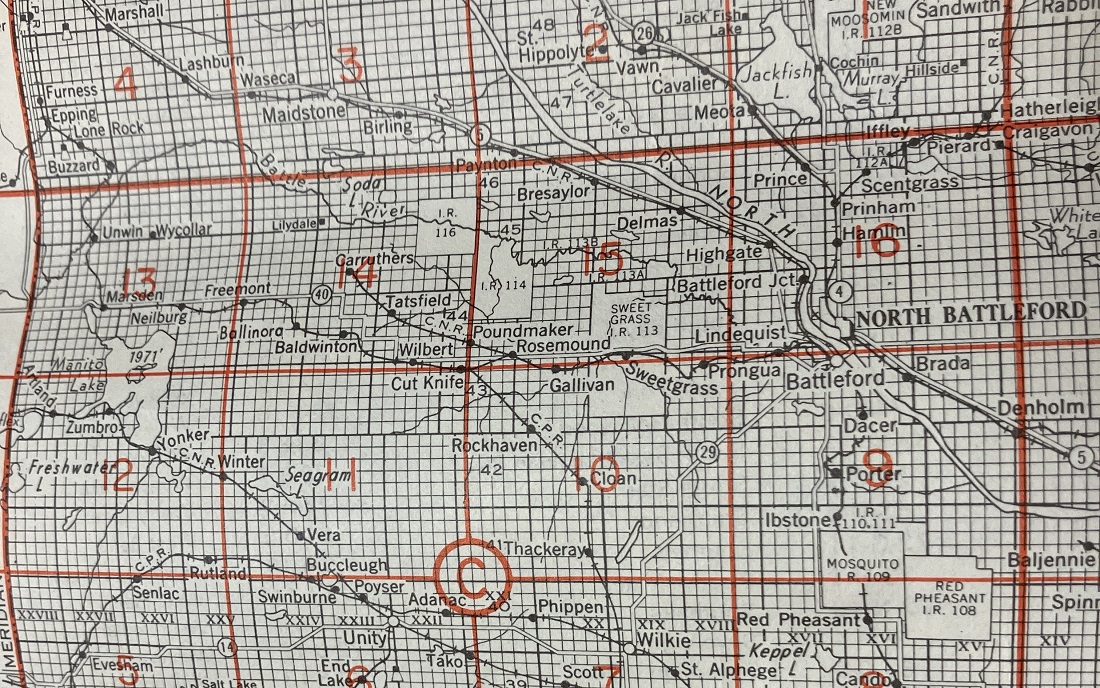
map of railways circa 1970s
Archives

Skill Testing Question…

The Clayton McLain Memorial Museum and Archives receives at least half a dozen research requests per year: someone may need a photograph for a publication, or information from a school ledger, or newspaper articles about a particular event. The types of requests are hugely varied. Most of the time we’re able to help. Other times, the relevant information just doesn’t exist in our archives.

Folks, this is one of those times.

We received a request from a researcher in Victoria, BC, who is looking into “early railway development in west Saskatchewan”, in particular the Canadian Pacific Railway’s (CPR) and the Grand Trunk Railway’s (GTR) first lines through the Cut Knife area. Information from “Where the Cut Knife Waters Flow Volume I” has already been forwarded.

This researcher is especially interested in the CPR-built line that connects the Town of Cut Knife on the CPR line to Rosemound on the GTR line. The map below shows that section.

Questions:

  • When was the Cut Knife to Rosemound connector built?
  • Why was it built?
CNR refers to the former GTR rail lines, which were purchased by the Canadian National Railway.

Of course, this is a long shot.

However, if you have any information at all about the CPR’s Cut Knife to Rosemound connector, whether it’s a family story, or a book / document / photo album with a reference in it, please comment below, or email the museum at cmmmcutknife@gmail.com. Also, we’d sure appreciate it if you passed this along to any of your railway enthusiast friends. Thank you!

~ Debbie M.