winter clothing
Archives, Museum, Our Stories

The School Concert, Part 1

PLANNING & REHEARSALS
winter clothing, teddy bears
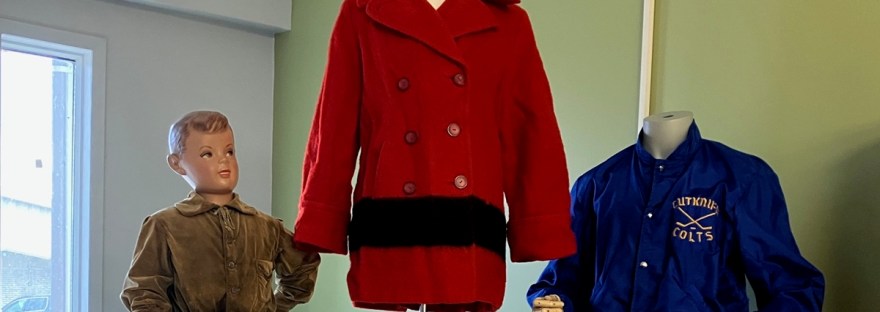
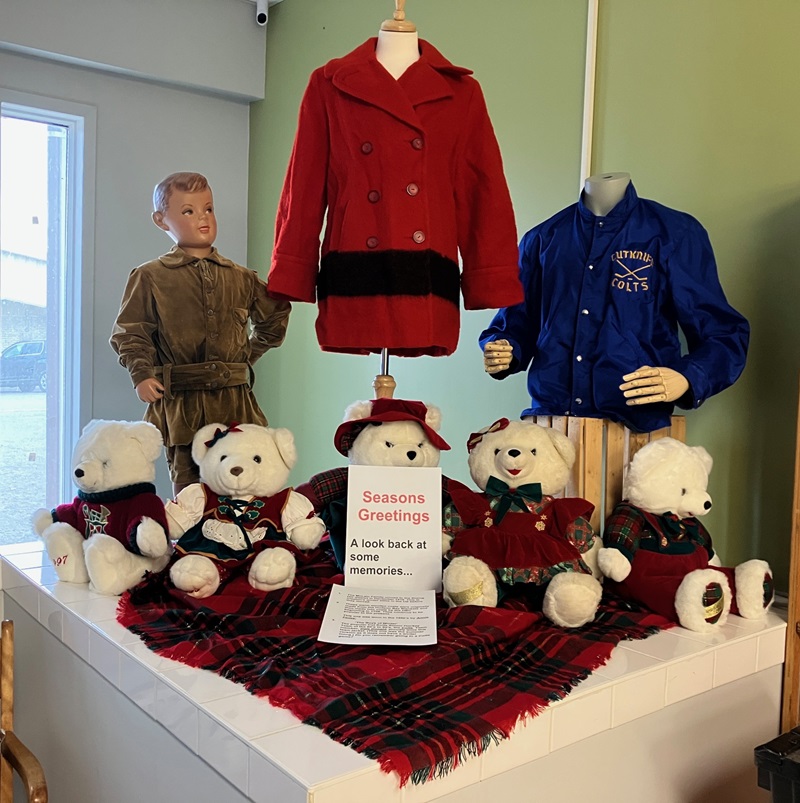
On display at the Cut Knife Library, left to right: Clayton’s winter clothing prior to moving to Riding Hill district; Annie Finlay’s HBC coat circa 1950’s; Cut Knife Senior Hockey Team member Dale Donald’s jacket circa 1960’s – ’80’s.

“My most memorable Christmas took place in the late 30’s. The Christmas Concerts in the one room schools made Christmas unforgettable. We had 3 ยฝ miles to go to a country school. Thirty to forty kids took part in a two hour program. Santa would arrive with a large bag which he carried on his back. The bag was filled with gifts and bags with candies, apples and oranges.” ~ Francis Busch, page 8

“Momโ€™s first teaching job in 1940 was at Tweedsmuir, a little country school north-east of Lloydminster. Preparing for the first Christmas concert was challenging because there was no piano and also because a teacher was often judged by the success of the concertโ€ฆ Mom said several of the parents told her it was one of the best concerts theyโ€™d had! The following year, the school had a piano and a local lady played for the concert. Mom was making $70.00 a month before deductions and paid the pianist $5.00! ~ Noreen Bullerwell written by Bonnie Ramsay, page 7

The concert would be coming soon, We each had a part to say.
Some were doing recitations, Others had parts in a play.
A platform must be built – With men helping it wonโ€™t take long.
It was exciting to stand upon that stage To practice our dance and song.
The girls would wear costumes, White crepe paper with a bow of red,
Carrying a wand topped with a star And a glitter crown upon the headโ€ฆ

Footnote: โ€ฆ this โ€œLittle School Houseโ€ was called โ€œGarthโ€ school and was situated five miles west of Rocky Mountain House, Alberta. That particular Christmas was December, 1936.โ€ ~ Marg Crittall, page 9

“Soon after Halloween, our teacher began choosing dialogues and recitations. Then by mid-November, it was practice for the Christmas Concert. It was a wonderful time – lots of music drills and choruses. We older girls got periods free to make silver wands – stars wrapped with silver paper. (Before aluminum foil!) There were always white crepe paper dresses for the girls and tinsel to be sewn on for halos and gold crowns for ‘We Three Kings’.” ~ Hazel Inkster, page 13

“Then I remember the drills we always did. The girls were all in one – we had frilly crepe paper dresses – usually long. I always felt really dressed upโ€ฆ The boys did another drill but I canโ€™t remember anything about them. It would have been something to do with soldiers I suppose. When I went to school at Wardenville, we were fortunate to have teachers who were excellent pianists so we always had good music for our concerts.” ~ Ruth (Bullerwell) Smith, page 57

“The preparation for the annual concert started about December 1st and must have been a real challenge for the teacher. All students had to have a part in the program whether they had talent in that area – or not! I always offered to be the stage manager – and pull the curtains! A Scottish lady in the district attempted to teach about 5 boys to dance the โ€œSailorโ€™s Hornpipeโ€. The first lessons were a disaster (canโ€™t you picture it?) but the final performance brought some clapping from the audience! Maybe it was our parents!” ~ Russ Stewart, page 59

“The girls did the musical drills of course. They had to wear frilly crepe paper costumes with bare legs. Us boys never looked at the legs, but we did have pea shooters made from a wooden clothes pin (patented by Barry Robinson) that made them stepโ€ฆ This meant that I had to write 500 lines after school. ‘I WILL NOT BRING BEANS TO SCHOOL’.” ~ Jim McEachern, page 17


Be sure to stop in tomorrow for The School Concert, Part 2. If you missed the Intro to Prairie Christmas yesterday, click here.

If you have any memories of early Christmases in the Cut Knife area that you’d like to share with our readership, please email or add to the comments below. We’ll put them all together in a final blog post in early January.

All excerpts in this Prairie Christmas blog series will have been taken from Prairie Christmas: A Collection of Stories and Recollections published as A Clayton McLain Memorial Museum Project, Cut Knife, Saskatchewan 2006 โ€“ 2007. Remaining copies are available for purchase for $10. See the websiteโ€™s Gift Shop page here.

~ Debbie M.
book cover of Prairie Christmas
Archives, Museum, Our Stories

Prairie Christmas

A Clayton McLain Memorial Museum Project 2006 – 2007

My original intention was to pull a half dozen excerpts from Prairie Christmas to accompany photos of the new seasonal exhibit in the Cut Knife Library. Having never read this compilation before, I didn’t know that would be an impossible task. I tried to just skim through for particular references but, by the end of the first story, I knew I was not going to miss a single word. This book is a treasure.

The memories shared on its pages are amusing or heartwarming or poignant, but always true to the moments being described. The Prairie Christmas Committee recognized the value of documenting these particular stories when they invited people to submit recollections of their early Christmas memories. The result is a wonderful historical overview of Christmas on the prairies, especially in the Cut Knife area, from the 1920s through to the 1950s.

Over the next week, I’ll be sharing excerpts from Prairie Christmas: A Collection of Stories and Recollections, which I’ve organized into some common threads i.e. the school concert, winter travel, Santa, shopping, turkey dinners, and more. Excerpts will be short paragraphs of descriptions, anecdotes, conversations etc. of which many will sound strikingly familiar all these years later.

Here’s a teaser from Russ Stewart:

The preparation for the annual concert started about December 1st and must have been a real challenge for the teacher. All students had to have a part in the program whether they had talent in that area – or not! I always offered to be the stage manager – and pull the curtains! A Scottish lady in the district attempted to teach about 5 boys to dance the โ€œSailorโ€™s Hornpipeโ€. The first lessons were a disaster (canโ€™t you picture it?) but the final performance brought some clapping from the audience! Maybe it was our parents!

Russ Stewart (page 59)

First up? Everyone had very vivid memories of their school concerts and many noted that the Christmas season began with concert programming and casting decisions in November or early December.

~ Debbie M.

Raymond's Store counter
Archives, Museum, Our Stories

Mom’s China, Dad’s Calendars, Your…

Every so often, following a Board meeting, we’ll stay behind to discuss the latest items on offer to the CMMM. Acquisitions meetings determine whether or not the Museum will accept or decline an artefact or the archival materials about which we’ve been contacted. Guidelines are in place to help make decision-making easier…

Our display space, our storage space and our volunteer resources are limited. By following our Significance Worksheet, we eliminate duplication and we maintain the museumโ€™s focus on the stories directly relevant to the area… we work at creating a unique, manageable collection reflective of the people, events and history of the Cut Knife area.

Acquisitions: To Accept a Donation . . . or Not?

… but it’s never really easy. One night after the accept / decline process we chatted on afterwards about having to make these decisions in our personal lives about our own parents’ possessions and collections:

  • How do you refuse your Mom’s table settings when she asks if you will take them?
  • What do you do if you end up, anyway, with multiple sets of china, or silverware, or crystal glassware after she passes?
  • Do you have a place to display, or even to store your Dad’s collection of carved wooden decoys, or license plates, or calendars?
  • How do you let something go that meant so much to them, and holds so many memories for you? What will happen to it if you don’t keep it?

These are the same kinds of questions the Museum struggles with too, each time we review an artefact. We want to be able to preserve the item, to display it, and to share it, not simply to store it.


Sadly, this Trustee had the final word that night. She was describing the conversation she had had with her daughter, when she asked if she’d take home her Grandmother’s set of silver. Her daughter reacted with “What am I going to do with a set of silver?” Her mom replied, “You can do exactly what I do with it. You take it out once a year. You polish it. Then you put it back until next year.”

~ Debbie M.

lest we forget
Archives, Museum, Our Stories

Nov. 11, 2023

To remember those who died in military service…

They will never know the beauty of this place, see the seasons change, enjoy natureโ€™s chorus. All we enjoy we owe to them, men and women who lie buried in the earth of foreign lands and in the seven seas.

Government of Canada

and to honour those who served in wartime…


NEW EXHIBIT: F. V. Burden, Rockhaven, SK

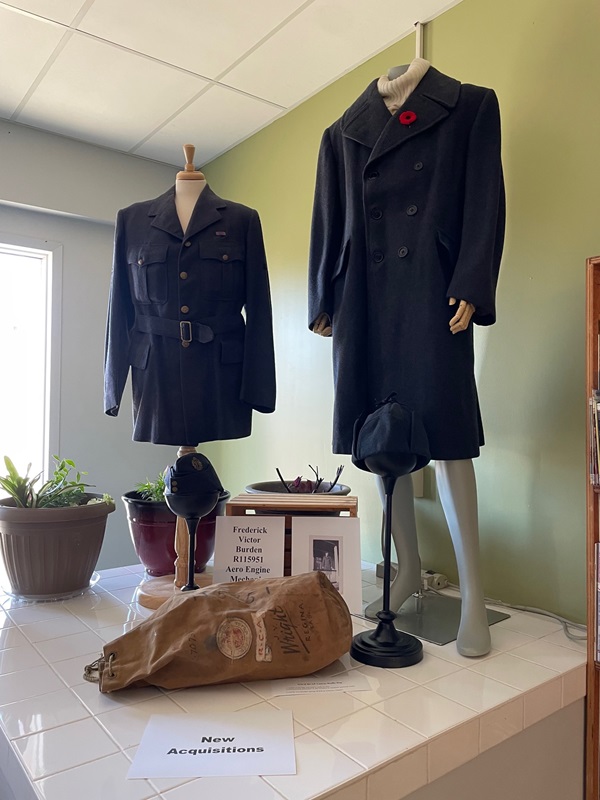
The CMMM’s most recent acquisitions are from the family of Frederick Victor Burden from the Rockhaven area. Vic Burden served in WW II as an Aero Engine Mechanic at RCAF Trenton in Ontario. Click here to read the full story of his service. His uniforms, documentation, and additional artifacts are currently on display in the Cut Knife Library.

Burden uniforms on display in library
Frederick Victor Burden’s uniforms and duffle bag on display in the Cut Knife Library. Visit at 113 Broad Street to view additional documents and artifacts.

~ Debbie M.

caf visitors in front of tomahawk
Archives, Museum, Summer

CAF Personnel Tour the Museum

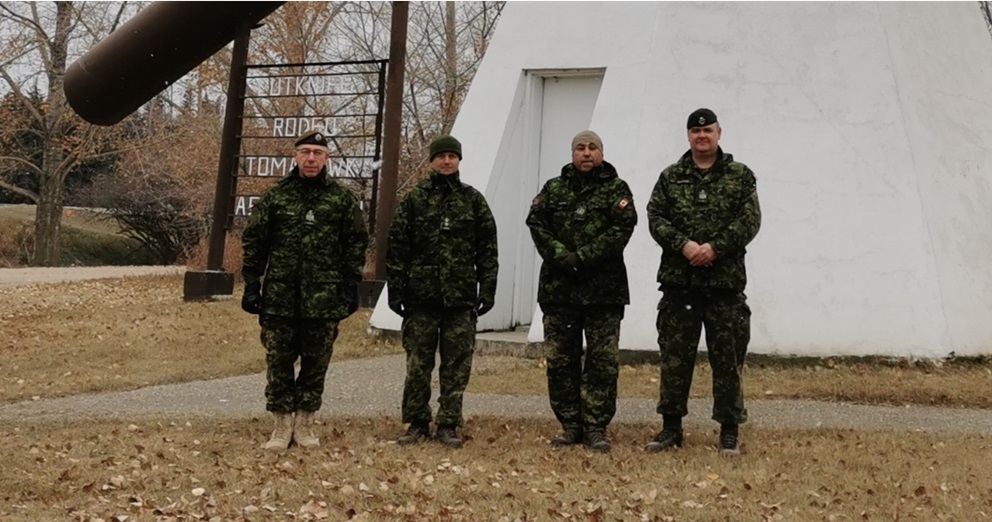
On Thursday, October 26, two members of the Canadian Armed Forces Governor General’s Foot Guards (Ottawa) and two members of the North Saskatchewan Regiment (Saskatoon) toured the Museum. They had travelled to the area to meet with Eric Tootoosis and other representatives of Poundmaker Cree Nation regarding potential Reconciliation activities in 2024. Eric then referred them to the Museum and Randy S. was available to tour them through the exhibits.

GOVERNOR GENERAL’S FOOT GUARDS

The Governor General’s Foot Guards (GGFG) was established in 1872 in Ottawa and is still headquartered there. Currently, the GGFG provide operational support to regular CAF deployments around the world including United Nations and NATO activities. It also has emergency response capabilities that assist Canadians during natural disasters or emergencies like the 1998 Ice Storm, floods, and the Covid-19 pandemic in 2020.

The GGFG’s first deployment was the Nile Expedition of 1884. Its second was in 1885:

Members of the Regiment… provided a company of sharpshooters to the Battleford column during the North West Rebellion, where the Regiment suffered its first two casualties at the battle of Cut Knife Hill.

Governor General’s Foot Guards: Our History

Lieutenant Colonel Jaime Bell (Commanding Officer) and Chief Warrant Officer Greg Witol (Regimental Sargeant Major) of the Governor General’s Foot Guards, and Chief Warrant Officer Jason Balcaen (Regimental Sargeant Major) and Master Warrant Officer Robert Brown (Indigenous Advisor to the Commander of the Canadian Army) of the North Saskatchewan Regiment enjoyed their tour. Of special note in the Exhibits building was the display of stone tools, the information on the 1885 Northwest Resistance, and from a military perspective, finding that the artillery used at the time had rifling on the projectile rather than the barrel of the gun. The group also spent some time going over the railway history of the North-West Territories, and the story of Bert Martin’s Cabin produced a chuckle.

Left to right: CWO Greg Witol, LCol Jaime Bell, MWO Robert Brown & CWO Jason Balcaen

~ Debbie M.