Museum, Our Stories

The Lake or Bust

TOMAHAWK PARK: PART 2 (OF MANY)

While the Cut Knife Rodeo Tomahawk Association was being formed, and tourism opportunities researched and discussed, the community was also fundraising for a building to house Clayton McLain’s collections. In July 1969, the Cut Knife Odd Fellows Lodge sponsored a Walkathon, one of many efforts carried out over the next few years, that led to the Clayton McLain Memorial Museum opening in 1971 on the Canada Day weekend.

In the face of an early morning downpour, muddy roads and threatening skies, 47 participants turned out to compete in the walkathon from Cut Knife to Atton’s Lake, a distance of 13 miles on July 6. The proceeds will initiate a fund to move the Ovenstown School from Cloan to Cut Knife.

It is a project of the Cut Knife Odd Fellows Lodge to have a district Museum to house the collection of mementoes of early life and settlement in the Cut Knife and Riding Hills, collected by the late Clayton McLain. The Ovenstown School, itself a fitting reminder of the earliest days of settlement in the Rockhaven – Cloan district and in later years serving the congregations of the United Church, was donated to house the exhibits. The site in the park area on the west side of town has been donated by the town, and will make an admirable setting for such a building…

A total of $1679.50 was raised in pledges…

~ from the Highway 40 Courier: Thursday, July 10, 1969 (page 5)
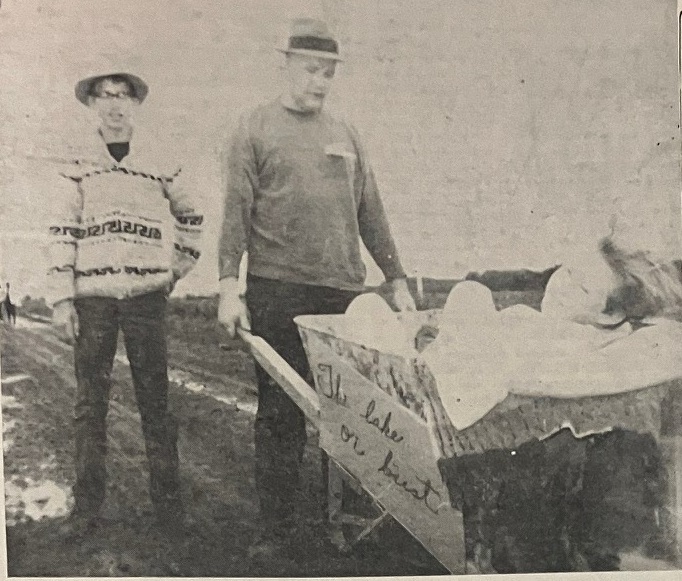

the lake or bust, july 1969 walkathon fundraiser
A walk-a-thon, with proceeds for the Cut Knife Museum fund, was held July 6 with walkers travelling the 13 gravelled miles from Cut Knife to Atton’s Lake. Recent rains made cool, and in some places rather muddy conditions for the participants. Among those completing the walk were Mrs. Vilda Laing, Gerald Hardy, Sylvia and Trevor McLain, Gordon Weikle of Cut Knife also arrived at his destination, travelling the miles the hard way, pushing wheel barrow and daughter over the bumpy miles.

Donโ€™t miss an installment of this local story. Click the FOLLOW button in the right side bar. Then enter your email address to receive post notifications.

To be continued…

~ Debbie M.

Museum, Our Stories

Wild Rodeo

TOMAHAWK PARK: PART I (OF MANY)

Highway 40 Courier: Thursday, October 2, 1969
Cut Knife Goes Western With Wild Rodeo, Front page

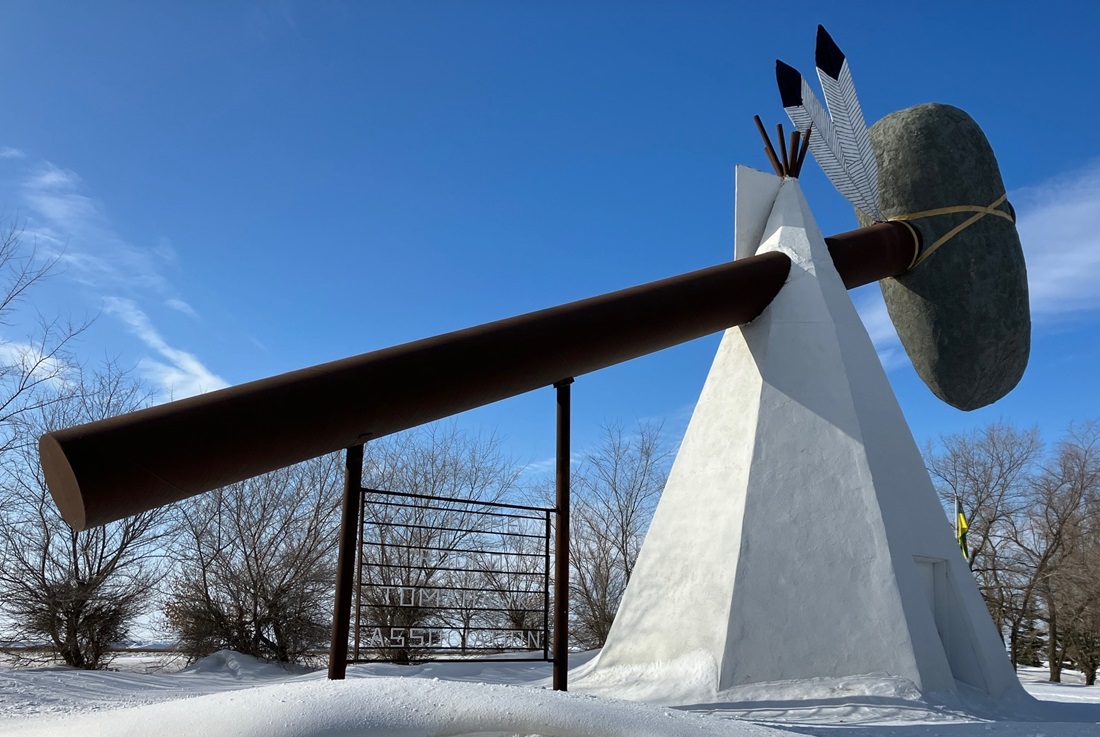
world's largest tomahawk, in winter, sign reading cut knife rodeo tomahawk association
“Cut Knife Rodeo Tomahawk Association” sign supporting the Tomahawk’s handle

Don’t miss an installment of this local story. Click the FOLLOW button in the right side bar. Then enter your email address to receive post notifications.

To be continued…

~ Debbie M.
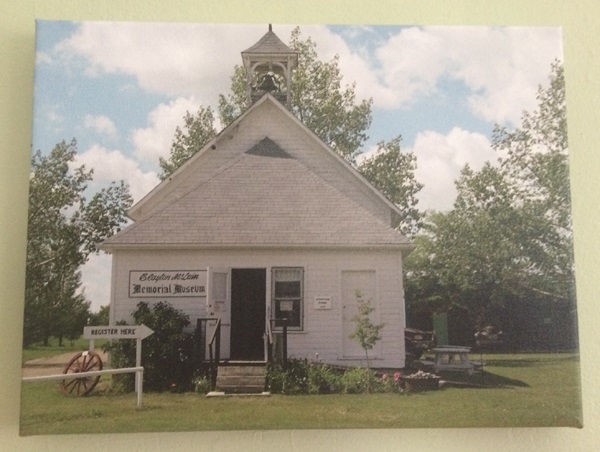
ovenstown registration building 1971 canvas print
Museum

Moving Forward

NEW TECHNOLOGIES COMING THIS WAY

ovenstown registration building 1971 canvas print
Ovenstown Registration circa 1971, canvas print hanging in the Duvall House

Back in the day, people carried cash or wrote cheques for admission to the CMMM. Donations, again, either by cash or cheque, were delivered in person or via Canada Post. There are many individuals who still carry cash and write cheques, but there are many, many others who don’t, and the Museum sees the difference.

Museum Admission

Admission is by donation and includes a guided tour of the Heritage buildings. Tours ensure the safety of visitors and the preservation of artefacts. Comments in the Visitors’ Book often express delight and appreciation for the tour, and for the guide who provided answers and shared additional anecdotes.

Visitors who arrive without cash in their pocket are still offered a tour. Some will make a quick trip to a cash machine and return momentarily. Others will leave with regrets. Those without cash-on-hand also miss the opportunity to purchase one of the local histories or gift items on display in the Duvall House.

Donations

The CMMM continues to receive annual contributions by cheque from long-time donors. Cash donations also come in at the Duvall House during Coffee Afternoons or with an Admission. All of these are put to good use: some on building repairs, some on exhibit maintenance; some on supplies i.e. printer ink, paper, laminating plastic, and so much more.

Alternatives to Cash & Cheques

Auto-deposit: This past fall, around the time of the Brick Fundraiser, the Museum enabled auto-deposit. No more security questions / answers required. It’s a relief for everyone. Use cmmmcutknife@gmail.com. One long-time donor used it recently for an annual contribution!

Canada Helps: This is a charity set up to facilitate online giving. Board members who have used it in the past recommend it as very user-friendly. To donate once, or monthly, click on the blue/green DONATE button on the Museum website to take you to the form, or visit our Canada Helps page here. Payment options are credit card, PayPal, or Google Pay. Canada Helps provides the tax receipt.

P.O.S. System (i.e. tap): We’ve done our research for internet service to the Duvall House and are eagerly awaiting its installation (date to be determined). It will enable a point-of-sale system to be available to visitors for admissions and / or donations. We’ll be announcing it’s arrival. Stay tuned!

As always, we are grateful for monetary donations of any amount but the community’s support also means so much i.e. attendance at events, word-of-mouth support to neighbours and friends, purchase of gift-shop items, sharing our posts on social media, and volunteering your time and energies to help with projects. Thank you!

~ Debbie M.

word research on cut knife grid road map
Archives, Museum

About Broncos & Western Horses

A RESEARCH REQUEST

Research requests are always varied and interesting, and it’s easy to get lost in the stories from decades ago. Just before Christmas, the Museum received a request for any information regarding Dan Munsell and the western horses he sold out east in the mid-1940’s.

THE FACTS

Dan Munsell had sold a carload of western horses to the lumbermen and farmers of the Sussex, NB area. [The researcher’s grandfather] had bought a team of horses from them. During this horse purchasing transaction, [the researcher’s father] was able to get to know Mr. Munsell and his stepson. 

After all the carload of horses were sold, Mr. Dan Munsell bought a second-hand car from a car dealer in St. John, NB. The car was a used 1940โ€™s dark green 4 door Chevrolet, which had a standard transmission, whose previous owner was a doctor in St. John. 

In early May 1946, [the researcher’s 19 year-old father] and his high school buddy Ernie started their fascinating journey west. They drove from Sussex, New Brunswick to Cut Knife, Saskatchewan with Dan Munsell and his stepson.

– from the request

FROM A LOCAL HISTORY BOOK

The researcher had numerous questions about the horses, their transportation out east, and other details. Unfortunately, very little information turned up in the Museum’s search. The following excerpt was the only direct reference:

When farming was horse power, the Munsell family were involved in securing and breaking bronchos. This meant they would go down to Medicine Hat, Alta. and drive back a number of head of range bronchos and then commence the work of breaking the animals to harness and work. When broken these were sold to other farmers in the area. This also meant that the problem of getting the animals to Cut Knife meant overland drives of many miles and several days duration.

from Blended Heritage: Zera Albert and Mary Ellen Munsell family history, page 773.

FROM A PRIMARY SOURCE

So Randy S. went looking further afield and offered up the following notes from Glen Brebner, a lifelong horse aficionado:

The horses referenced as broncos in the text were likely feral horses from the Alberta foothills. They were smaller, tougher, and stronger, and were captured, broke, and sold for work in those days. They were sometimes called cayuses or broomtails because of their long bushy tails which they’d turn to the wind to protect themselves from the cold in the winter and which would swish flies in the summer.

Glen says that sometimes people would try to “improve” these horses by culling out their natural stallions and substituting draught horse stallions to try to increase the size. The curious thing is that the interbreeding would only take for one generation, then the horses would always revert to their smaller ancestors. They were often sold for work around Saskatchewan and transported to the east coast by rail car.

from a conversation between Glen Brebner and Randy S.

So many stories, so little time…

~ Debbie M.

Royal Bank calendar 1963
Archives, Museum, Our Stories

Calendars for a New Year

“SPONSORED CONTENT” BELOW

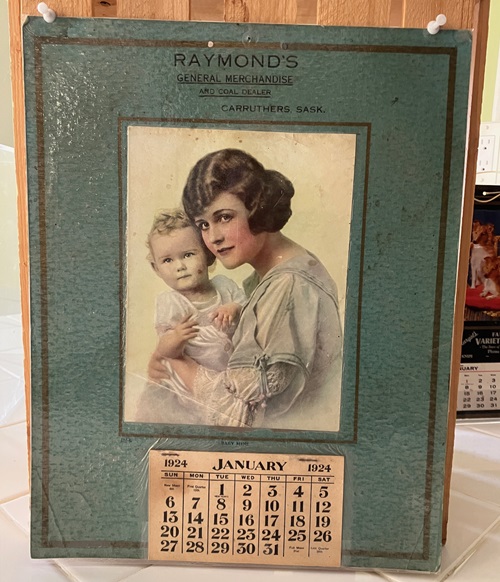
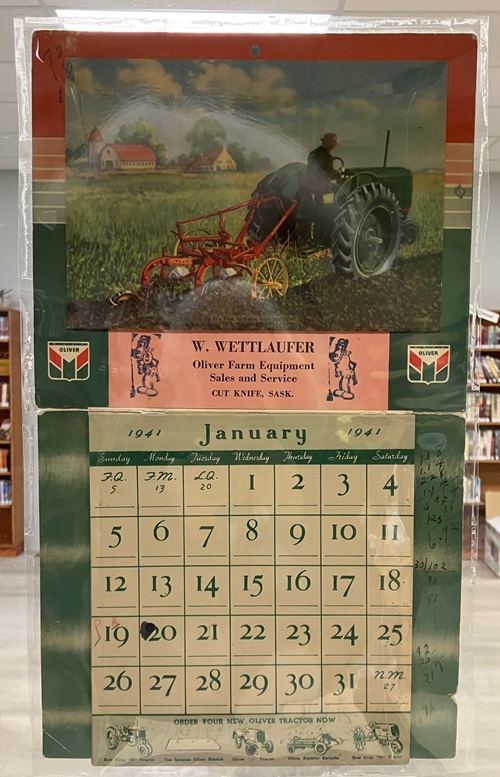
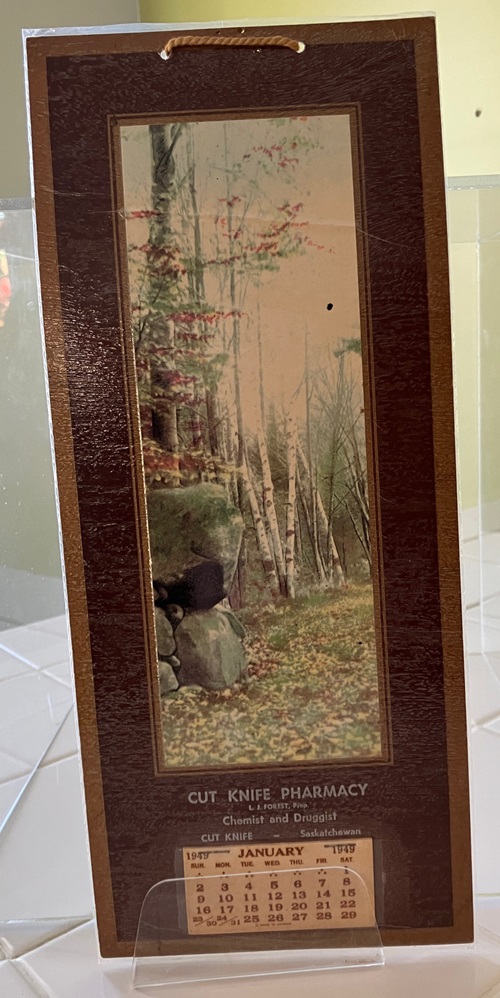
CMMM’s current display in the Cut Knife Library features vintage calendars from former area businesses and from a few companies still operating today. Years represented range from the mid-1920’s to the late-1970’s. As marketing materials and as customer appreciation items, these sponsored calendars were a useful tool for families and also provided easily accessible contact information. Many also featured beautiful art work, photography and / or typesetting. Here are a few examples.

Raymond’s General Merchandise & Coal Dealer, Carruthers, 1924

W. Wettlaufer, Oliver Farm Equipment Sales & Service, Cut Knife, 1941

Cut Knife Pharmacy, L. I. Forest, Prop, Chemist & Druggist, 1949

Elgar Coffee Bar, Home Cooked Meals, Cut Knife, 1962

Jack Parkinson & Family, Your Imperial Oil Agent, Cut Knife, 1978

These calendars and in fact, all of our Library exhibits, are best viewed in person as the overhead lighting and the limitations of the glass cases make for poor photos. To browse the complete exhibit which includes another dozen calendars, visit 113 Broad Street.

~ Debbie M.