Raymond's Store counter
Archives, Museum, Our Stories

Mom’s China, Dad’s Calendars, Your…

Every so often, following a Board meeting, we’ll stay behind to discuss the latest items on offer to the CMMM. Acquisitions meetings determine whether or not the Museum will accept or decline an artefact or the archival materials about which we’ve been contacted. Guidelines are in place to help make decision-making easier…

Our display space, our storage space and our volunteer resources are limited. By following our Significance Worksheet, we eliminate duplication and we maintain the museumโ€™s focus on the stories directly relevant to the area… we work at creating a unique, manageable collection reflective of the people, events and history of the Cut Knife area.

Acquisitions: To Accept a Donation . . . or Not?

… but it’s never really easy. One night after the accept / decline process we chatted on afterwards about having to make these decisions in our personal lives about our own parents’ possessions and collections:

  • How do you refuse your Mom’s table settings when she asks if you will take them?
  • What do you do if you end up, anyway, with multiple sets of china, or silverware, or crystal glassware after she passes?
  • Do you have a place to display, or even to store your Dad’s collection of carved wooden decoys, or license plates, or calendars?
  • How do you let something go that meant so much to them, and holds so many memories for you? What will happen to it if you don’t keep it?

These are the same kinds of questions the Museum struggles with too, each time we review an artefact. We want to be able to preserve the item, to display it, and to share it, not simply to store it.


Sadly, this Trustee had the final word that night. She was describing the conversation she had had with her daughter, when she asked if she’d take home her Grandmother’s set of silver. Her daughter reacted with “What am I going to do with a set of silver?” Her mom replied, “You can do exactly what I do with it. You take it out once a year. You polish it. Then you put it back until next year.”

~ Debbie M.
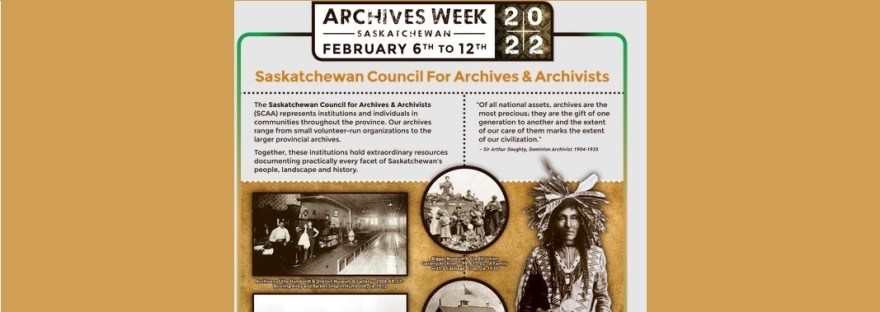
scaa archives week 2022
Archives

Congratulations SCAA!

Saskatchewan Council for Archives and Archivists Wins Award

On November 8, 2023, the SCAA was the recipient of a 2023 Saskatchewan Heritage Award for their Archives Week Video Project 2022. The Heritage Saskatchewan award presentations took place at Government House in Regina.

ABOUT THE PROJECT

The Archives Week Video Project 2022 was created by our team to celebrate the annual SCAA Archives Week in a series of daily video clips whereby our members showcased their successes and achievements of the past year; and also displayed the hard work and dedication of archivists in preserving the vibrant history of the province.

Saskatchewan Council of Archives and Archivists media release

THE CMMM ARCHIVES

The CMMM has been a member of the SCAA for more than a dozen years. When all of our archival materials came together under one roof, the SCAA Archives Advisor made a trip to Cut Knife to advise on its set up. They have continued to support us with information, recommendations, and at times, funding. We have participated in Saskatchewan Archives Week activities with Open Houses, digital exhibits, and blog posts focusing on local research. Our Resident Archivist, Lucille B. and many other Board members and volunteers have taken SCAA course work in a wide variety of archival topics.

The work of the SCAA in this province is vital to the preservation of local histories. The Cut Knife Museum and Archives congratulates the SCAA organization and all of the individuals involved with the Archives Week Video Project 2022 for this well-deserved recognition.

~ Debbie M.

lest we forget
Archives, Museum, Our Stories

Nov. 11, 2023

To remember those who died in military service…

They will never know the beauty of this place, see the seasons change, enjoy natureโ€™s chorus. All we enjoy we owe to them, men and women who lie buried in the earth of foreign lands and in the seven seas.

Government of Canada

and to honour those who served in wartime…


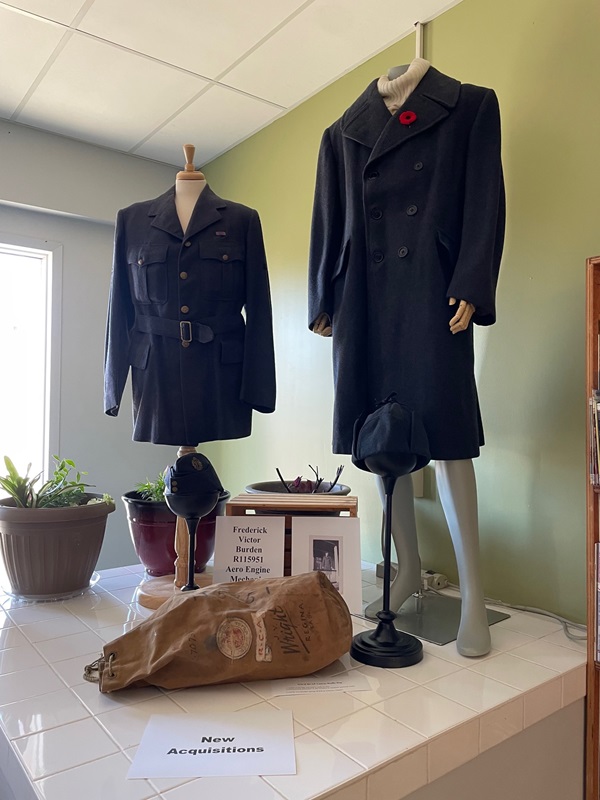
NEW EXHIBIT: F. V. Burden, Rockhaven, SK

The CMMM’s most recent acquisitions are from the family of Frederick Victor Burden from the Rockhaven area. Vic Burden served in WW II as an Aero Engine Mechanic at RCAF Trenton in Ontario. Click here to read the full story of his service. His uniforms, documentation, and additional artifacts are currently on display in the Cut Knife Library.

Burden uniforms on display in library
Frederick Victor Burden’s uniforms and duffle bag on display in the Cut Knife Library. Visit at 113 Broad Street to view additional documents and artifacts.

~ Debbie M.

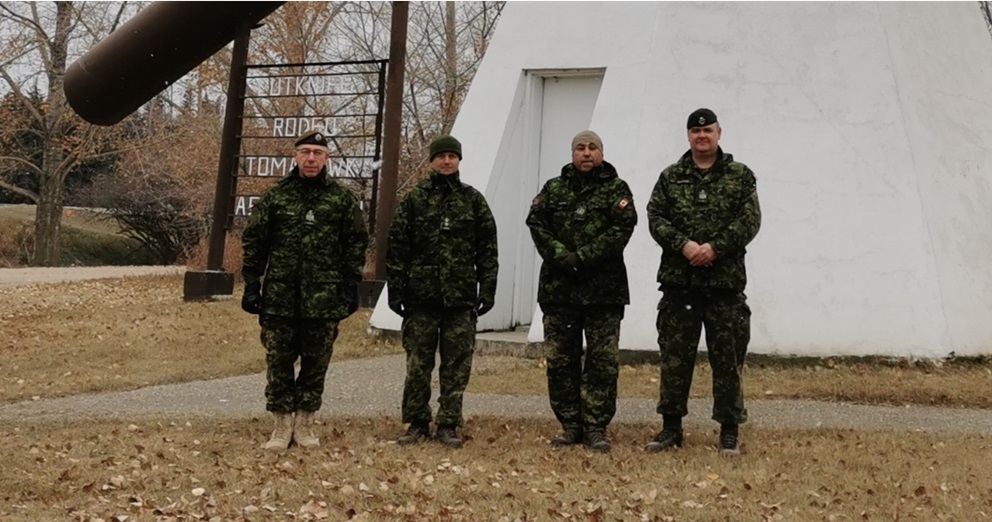
caf visitors in front of tomahawk
Archives, Museum, Summer

CAF Personnel Tour the Museum

On Thursday, October 26, two members of the Canadian Armed Forces Governor General’s Foot Guards (Ottawa) and two members of the North Saskatchewan Regiment (Saskatoon) toured the Museum. They had travelled to the area to meet with Eric Tootoosis and other representatives of Poundmaker Cree Nation regarding potential Reconciliation activities in 2024. Eric then referred them to the Museum and Randy S. was available to tour them through the exhibits.

GOVERNOR GENERAL’S FOOT GUARDS

The Governor General’s Foot Guards (GGFG) was established in 1872 in Ottawa and is still headquartered there. Currently, the GGFG provide operational support to regular CAF deployments around the world including United Nations and NATO activities. It also has emergency response capabilities that assist Canadians during natural disasters or emergencies like the 1998 Ice Storm, floods, and the Covid-19 pandemic in 2020.

The GGFG’s first deployment was the Nile Expedition of 1884. Its second was in 1885:

Members of the Regiment… provided a company of sharpshooters to the Battleford column during the North West Rebellion, where the Regiment suffered its first two casualties at the battle of Cut Knife Hill.

Governor General’s Foot Guards: Our History

Lieutenant Colonel Jaime Bell (Commanding Officer) and Chief Warrant Officer Greg Witol (Regimental Sargeant Major) of the Governor General’s Foot Guards, and Chief Warrant Officer Jason Balcaen (Regimental Sargeant Major) and Master Warrant Officer Robert Brown (Indigenous Advisor to the Commander of the Canadian Army) of the North Saskatchewan Regiment enjoyed their tour. Of special note in the Exhibits building was the display of stone tools, the information on the 1885 Northwest Resistance, and from a military perspective, finding that the artillery used at the time had rifling on the projectile rather than the barrel of the gun. The group also spent some time going over the railway history of the North-West Territories, and the story of Bert Martin’s Cabin produced a chuckle.

Left to right: CWO Greg Witol, LCol Jaime Bell, MWO Robert Brown & CWO Jason Balcaen

~ Debbie M.

typewriter keys
Archives, Museum, Our Stories

Amy’s Typewriter

Amy Rowswell (nรฉe Stephens) purchased this Remington Portable No. 5 typewriter in 1942. At the time, she was a student at the Normal School in Saskatoon studying to be a teacher. After receiving her certificate, she returned to Rockhaven to teach at Baldwinton, where she met Jack Rowswell. They married in 1952. Amy and Jack farmed south of Baldwinton, had three children, and eventually retired to the Town of Cut Knife.

Amy passed away in June 2023 and her family has kindly donated numerous items of historical value to the Clayton McLain Memorial Museum. Many personal stories will be attached to this machine. After all, it had been a part of the family for more than 80 years. However, this machine is also valuable in that Amy’s story points us to other stories, too.

THE TYPEWRITER

The idea of the typewriter first appears in 1714 as a Machine for Transcribing Letters, then again in 1830 as a typographer, but it’s not until the mid-1870s, that the typewriter appears on the market. Philo Remington, gun manufacturer, had purchased the production rights from Sholes, Soulรฉ, and Glidden in 1873. In 1874, the Remington No. 1 was in production. By 1942, when Amy purchased her machine, typewriters were everywhere.

Typewriters became commonplace in office settings but also in peopleโ€™s homes. They transformed the way people composed and produced written content and facilitate the process of manuscript preparation, typing letters and drafting professional documents.

The History of the Typewriter

THE NORMAL SCHOOL

Normal Schools were teacher training facilities created and funded by provincial governments. These institutions were designed to address the increased need for elementary school educators in the newly established public education systems.

The term “normal” derived from France’s ร‰cole normale supรฉrieure of the 1790s, and implied that teaching methods used therein would become the norm for all schools within the government’s jurisdiction.

The Canadian Encyclopedia

ONE-ROOM SCHOOLS

The school at Baldwinton, SD #4762, was one of many hundreds of one-room schoolhouses built in Saskatchewan in the early days of settlement. As both population and educational expectations increased, one-room schools were replaced with larger buildings appropriate for separate grade levels and multiple teachers. Baldwinton was in operation from 1929 – 1965.

These buildings were respected as centers of learning; they hosted community events; they were recognized as the framework within which the community grew โ€“ for the years they remained open. 

Clayton McLain Memorial Museum
Amy Rowswell’s Remington Portable No. 5

~ Debbie M.