BLOG

gallery header
Spare Room Gallery

What Kind of Art Gallery?

DIFFERENT TYPES… (WHO KNEW?)

If you didn’t know, and to be honest, a few of us at that first meeting didn’t, there are different types of art galleries. Listed below are the two main types with very brief descriptions of the differences between them.

COMMERCIAL: These include private galleries, co-operative galleries, vanity galleries, and more. Commercial galleries are businesses set up specifically to sell art. Some of these galleries offer additional services like rentals, home decor, or gift shops. Artists for these venues are selected to suit a particular clientele, or to make a splash in the art world, but always to be profitable for the gallery through sales.

PUBLIC: These galleries are usually established at the municipal level in the public’s interest. They tend to showcase and celebrate local, regional, and / or under-represented artists and creators. Public galleries operate as not-for-profits and may receive funding through granting organizations, donations, and / or memberships.

This gallery will be set up as a non-profit division of the Clayton McLain Memorial Museum. It will have its own funding and Advisory Committee. The gallery will seek submissions from artists within an approx. 80 kilometer radius.

First things first, though…

Do you have some free time and a soft spot for the visual arts? If so, help us establish this gallery space for the artists and arts enthusiasts of Cut Knife and surrounding area. Email Randy at cmmmcutknife@gmail.com.

~ Debbie M.

word research on cut knife grid road map
Archives, Museum

About Broncos & Western Horses

A RESEARCH REQUEST

Research requests are always varied and interesting, and it’s easy to get lost in the stories from decades ago. Just before Christmas, the Museum received a request for any information regarding Dan Munsell and the western horses he sold out east in the mid-1940’s.

THE FACTS

Dan Munsell had sold a carload of western horses to the lumbermen and farmers of the Sussex, NB area. [The researcher’s grandfather] had bought a team of horses from them. During this horse purchasing transaction, [the researcher’s father] was able to get to know Mr. Munsell and his stepson. 

After all the carload of horses were sold, Mr. Dan Munsell bought a second-hand car from a car dealer in St. John, NB. The car was a used 1940โ€™s dark green 4 door Chevrolet, which had a standard transmission, whose previous owner was a doctor in St. John. 

In early May 1946, [the researcher’s 19 year-old father] and his high school buddy Ernie started their fascinating journey west. They drove from Sussex, New Brunswick to Cut Knife, Saskatchewan with Dan Munsell and his stepson.

– from the request

FROM A LOCAL HISTORY BOOK

The researcher had numerous questions about the horses, their transportation out east, and other details. Unfortunately, very little information turned up in the Museum’s search. The following excerpt was the only direct reference:

When farming was horse power, the Munsell family were involved in securing and breaking bronchos. This meant they would go down to Medicine Hat, Alta. and drive back a number of head of range bronchos and then commence the work of breaking the animals to harness and work. When broken these were sold to other farmers in the area. This also meant that the problem of getting the animals to Cut Knife meant overland drives of many miles and several days duration.

from Blended Heritage: Zera Albert and Mary Ellen Munsell family history, page 773.

FROM A PRIMARY SOURCE

So Randy S. went looking further afield and offered up the following notes from Glen Brebner, a lifelong horse aficionado:

The horses referenced as broncos in the text were likely feral horses from the Alberta foothills. They were smaller, tougher, and stronger, and were captured, broke, and sold for work in those days. They were sometimes called cayuses or broomtails because of their long bushy tails which they’d turn to the wind to protect themselves from the cold in the winter and which would swish flies in the summer.

Glen says that sometimes people would try to “improve” these horses by culling out their natural stallions and substituting draught horse stallions to try to increase the size. The curious thing is that the interbreeding would only take for one generation, then the horses would always revert to their smaller ancestors. They were often sold for work around Saskatchewan and transported to the east coast by rail car.

from a conversation between Glen Brebner and Randy S.

So many stories, so little time…

~ Debbie M.

gallery header
Spare Room Gallery

The Spare Room

At 113 Broad Street, the relatively “new” home of the Cut Knife Library and the Museum’s Admin. & Archives Centre (MAAC), is a small room to the right of the front entry way. In early planning stages, this street-facing room was to be an office rental however, that idea was impractical. The Library’s Used Book Sale has occupied it most recently but is now winding down. Currently, an initiative has begun that hopes to transform that ‘spare’ room into a gallery / visual arts space.

The Board of Trustees of the CMMM passed a motion at their November meeting to support the development of an art gallery that would have its own advisory committee and its own funding but would operate as a division of the Museum and share its corporate infrastructure. The Town of Cut Knife has also expressed its support for the creation of an art gallery in the building. An informal poll of Cut Knife and area artists and creators via Facebook produced a very positive reaction and has prompted the working group to begin planning next steps.

With that in mind, keep your eye on the Museum’s blog and Facebook page for updates, for next steps and, of course, for calls for volunteers, donors, and artists.

Interested in being a part of the gallery working group? Have questions? Email Randy Strelioff at cmmmcutknife@gmail.com.

~ Debbie M.

Royal Bank calendar 1963
Archives, Museum, Our Stories

Calendars for a New Year

“SPONSORED CONTENT” BELOW

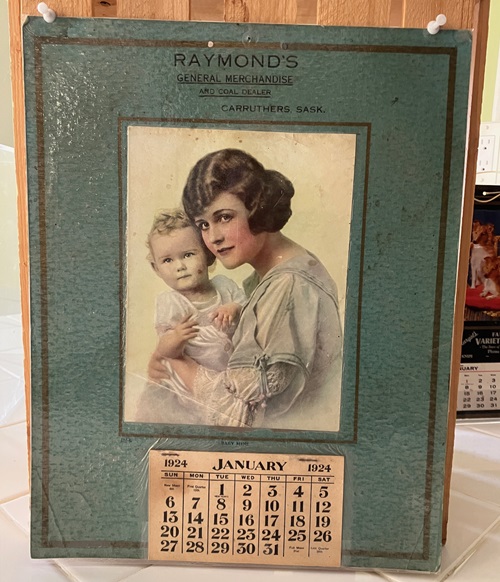
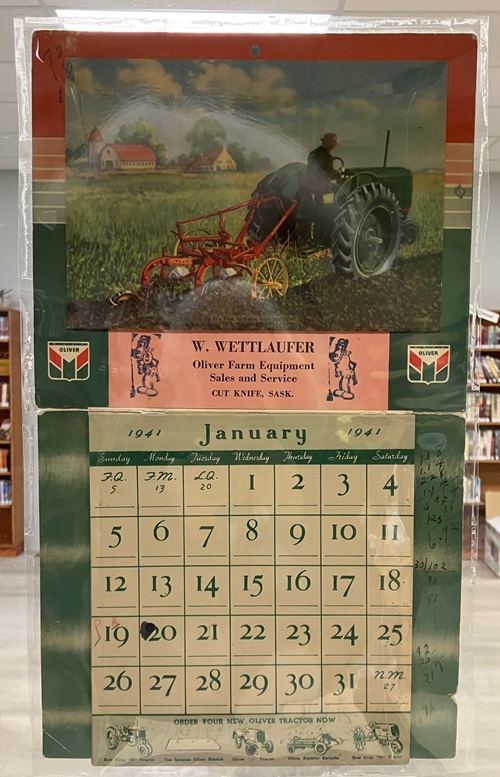
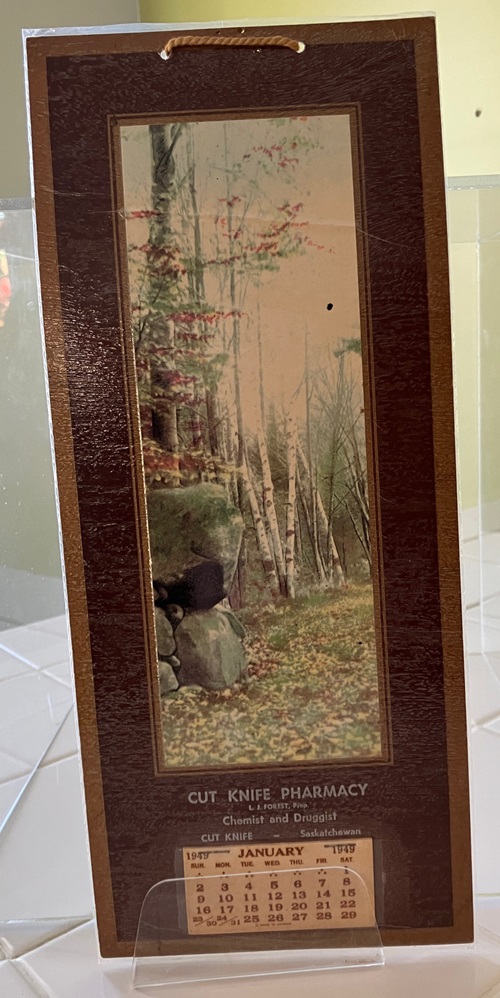
CMMM’s current display in the Cut Knife Library features vintage calendars from former area businesses and from a few companies still operating today. Years represented range from the mid-1920’s to the late-1970’s. As marketing materials and as customer appreciation items, these sponsored calendars were a useful tool for families and also provided easily accessible contact information. Many also featured beautiful art work, photography and / or typesetting. Here are a few examples.

Raymond’s General Merchandise & Coal Dealer, Carruthers, 1924

W. Wettlaufer, Oliver Farm Equipment Sales & Service, Cut Knife, 1941

Cut Knife Pharmacy, L. I. Forest, Prop, Chemist & Druggist, 1949

Elgar Coffee Bar, Home Cooked Meals, Cut Knife, 1962

Jack Parkinson & Family, Your Imperial Oil Agent, Cut Knife, 1978

These calendars and in fact, all of our Library exhibits, are best viewed in person as the overhead lighting and the limitations of the glass cases make for poor photos. To browse the complete exhibit which includes another dozen calendars, visit 113 Broad Street.

~ Debbie M.

patterson's freshpack chocolates
Archives, Museum, Our Stories

Winding Up “Prairie Christmas”

SERIES LINKS | BOOKS FOR SALE | MORE MEMORIES

patterson's freshpack chocolates
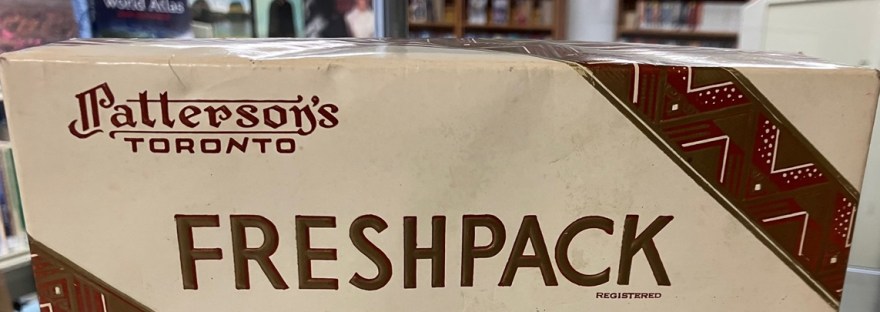
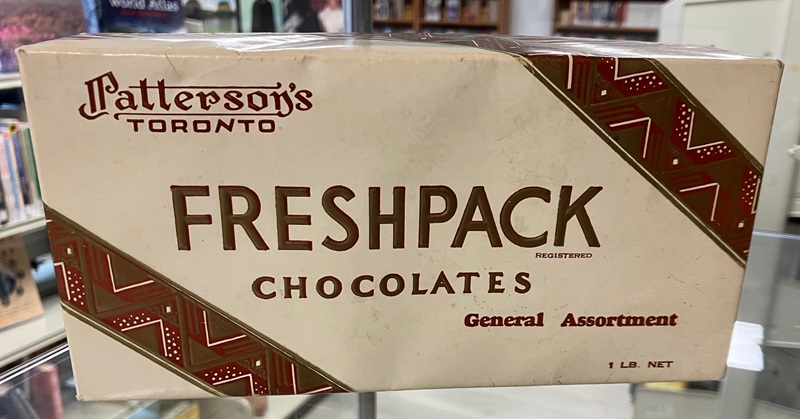
Patterson’s Freshpack Chocolates

Sending out our appreciation to all the blog readers, and Facebook friends who read, and shared, and commented (and liked and loved) this series of posts. Thank you so much!

In case you missed any of the Prairie Christmas posts, links are here:

All excerpts taken from Prairie Christmas: A Collection of Stories and Recollections published as A Clayton McLain Memorial Museum Project, Cut Knife, Saskatchewan 2006 โ€“ 2007.

We have 4 copies of Prairie Christmas remaining. We accept e-transfers to cmmmcutknife@gmail.com, cheques and cash. Arrangements can be made to pick up in Town. Shipping costs are extra. Visit the Gift Shop here. Email first to confirm availability.

A few additional memories submitted by our readers:

In response to the question, “Folks, looks like CK’s Santa Claus Day may have started back in the 1950’s. That’s ** 70 ** years ago! Anyone reading this able to confirm?” Robert R Loranger replied:

Have fond memories of Santa day, there were four of us children, our family was poor and treats were not plentiful, so the bag of candy and the picture show in the old theater was a big day. I know it is seventy plus years. Thank you to the Elks for keeping it going all these years. Has made many good memories for many children over the years. There is still a Loranger living in Cut Knife and that is five generations, soon to be six. Merry Christmas everyone.

Facebook, December 21, 2023

Actors: Lorraine Bertrand, Herb Wilkinson, Kay Buglas

Lorraine (Bertrand/Birstein) Martin: Christmas Concerts were always a favourite time for us as we grew up. What child does not like Christmas Concerts?


All the Gallivan school teachers would start looking for Christmas skits, poems and songs, in late November. We would be assigned to a part and practicing would begin in December. We looked forward to the night of the concert. Many parents assisted with the preparation and goody bags. Each child got some little toy along with the candy, nuts and a Christmas orange. Santa Claus was the biggest hit when we would try to guess which farmer was under the beard.

When I was in grade nine, Peggy Durant, the public school teacher, taught a few of us girls to tap dance. We learned a few steps and were ready to perform at the Christmas concert. Our performing costume was a short skirt made of coloured crepe paper with a rope of silver trim on it. Peggy (Margaret) Ovens, Bernice Gallivan and I danced the routine of โ€œtime steps, break, tap back, touching steps, heel steps, turning steps, heel step left, heel step rightโ€. We were watched and chuckled at by the male population who stood in the back of the hall as we bounced our mature forms with every step.

The Gallivan high school students put on a play under the direction of Mr. Wilkinson. It was named, โ€œOur Dream Houseโ€. We spent several evenings at the Hall practicing. We also performed it at one of the 4-H Club events.

from Notes and Clippings: It all Started in Saskatchewan, page 25

~ Debbie M.