Archives, Our Stories

Archives Week 2023

Of all national assets, archives are the most precious; they are the gift of one generation to another and the extent of our care of them marks the extent of our civilization.

Sir Arthur Doughty, Dominion Archivist 1904 – 1935

The Clayton McLain Memorial Museum Archives was established in 2009 under the guidance of the Saskatchewan Council of Archives and Archivists (SCAA). This brought all the materials displayed and stored onsite in the heritage buildings into one location, where a climate-controlled and pest free environment would ensure their safety and longevity. All materials are being organized and classified according to archives industry standards.

The CMMM Archives are in transition from their home in the Museum Administration & Archive Centre (MAAC) at 201 Railway Avenue to their soon-to-be new home at 113 Broad Street, which also houses the Cut Knife Municipal Library. MAAC2 will be located at the rear of the building with a separate entrance. Watch for a spring-time public event to celebrate our new home!

In the meantime, we’ll be sharing a few archival-related items on the blog this week. If you’d like to see what’s going on in archives across the province, check out the list of events on the SCAA’s website at the link below.

Click here to view Archives Week activities throughout the province.


From the 2023 SCAA Archives Week poster:

Sunday, February 5 – Saturday, February 11

The Saskatchewan Society of Archives and Archivists (SCAA) represents institutions and individuals in communities throughout the province. Our archives range from small volunteer-run organizations to the larger provincial archives.

archives week 2023 saskatchewan council for archives and archivists poster

~ Debbie M.

outdoor exhibit machinery
Museum, Our Stories

Except One Thing

Angie has been working the summer seasons at the Clayton McLain Memorial Museum since 2016. She’s the Staff Supervisor, Tour Guide, Jack-of-all-Trades, and most importantly, Assistant Curator who catalogues as many artifacts as she can, each summer, in between all of the above tasks and responsibilities. We are extremely fortunate that she is happy to return to the museum year after year.

A few weeks ago, we were talking about visitors to the CMMM and their responses to the Heritage Village. Angie noted that one of the most frequent comments she hears is, “You’ve got EVERYTHING here!” And, Angie’s response is always, “Everything. Except one thing.” Of course, we all want to know what that one thing is, and Angie’s answer surprised me, too.

The answer is jeans. Not just any old jeans, though. Angie’s referring to an authentic pair of old bib overalls that have a direct connection to the area. She said, “just ask if anybody still has a pair of Grandpa’s old jeans tucked away somewhere.” Unfortunately, both Angie and I know it’s not quite that simple.

For anyone who has an item they’re considering giving / donating / passing along to the museum, the Acquisitions Committee follows a strict set of guidelines to determine if a particular item should be added to the CMMM collections.

Read more:

On the other hand, a pair of Grandpa’s old bib overalls HAS to be relevant to the history of the area, doesn’t it?

~ Debbie M.

Museum, Our Stories

The Reel Mower

Outdoor exhibits at the Museum include farm equipment, different modes of transportation, and a wide variety of tools. Pictured below is a vintage lawn mower. If you’re a person ‘of a certain age’, you may have actually used a machine similar to this one in your youth.

The first lawn mower was invented in England, in the 1830s by Edwin Beard Budding. By the 1900s, mechanized mowers powered by gasoline were on the market. Rubber tires came on the scene in the mid-1930s and, in the beginning, were an optional purchase. Gasoline and electric powered lawn mowers have been the norm since the middle of the last century and the technology for this tool continues to evolve. Now in stores are battery powered machines and, believe it or not, the reel mower is making a comeback!

For more information about the museum grounds, click here.

~ Debbie M.

chief poundmaker grave
Our Stories

Different Cultures, Prairie Neighbours

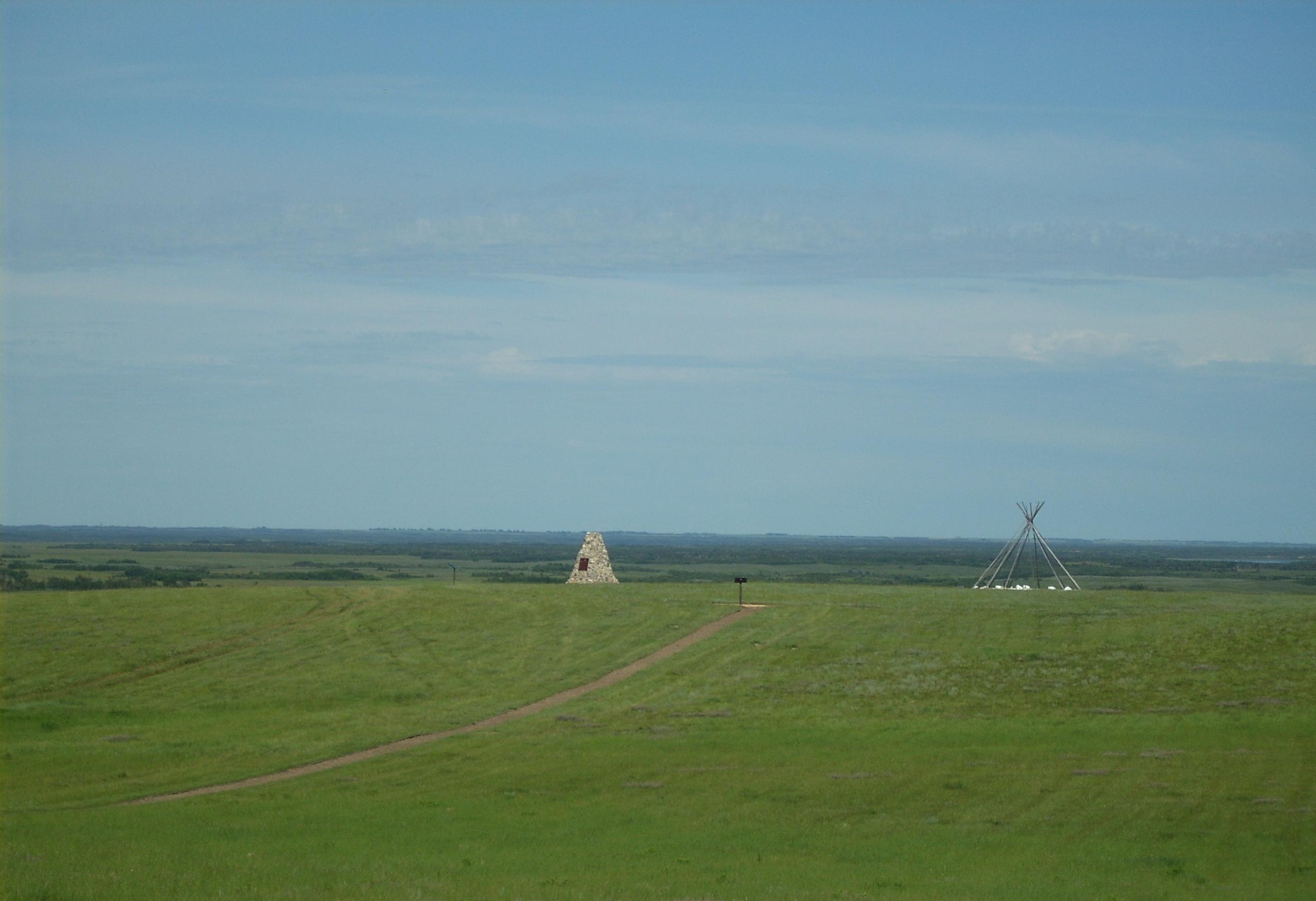
Cultures, political systems, religious persuasions and individual personalities have influenced the degree of peace that existed, here, between neighbours. Our museum would like to understand these events so that we may learn from the mistakes, celebrate the successes and promote understanding and acceptance. Just north of the Cut Knife town site, two historic battles took place:

BATTLE AT BROKEN KNIFE’S LOOKOUT

This battle was fought at the highest hill in the area, in the 1840s, between the Cree and the Tsuutโ€™ina (formerly known as the Sarcee) from the Blackfoot Confederacy. The invading Tsuutโ€™ina chief, Broken Knife (later loosely translated to Cut Knife), was defeated. But, the Cree had greatly appreciated his fighting ability and so named the hill after him to honour his skill. One of the Sarcee warriors escaped and returned to his home to tell the story.

chief poundmaker grave
Chief Poundmaker Historic Site

When the town forefathers were looking to name the settlement, they decided to use the name of the hill as it was a significant landmark to the north.

In 2016, a monument was erected on Broken Knife’s Lookout to commemorate the event and to relate the story from both the Cree and the Tsuut’ina perspective. Broken Knife’s Lookout – Nation to Nation Reconciliation

BATTLE AT CUT KNIFE CREEK HILL

The 1885 Battle at Cut Knife Creek was one of a series of violent outbreaks which came to be known as the Northwest Resistance. Federal troops, under the command of Lieutenant-Colonel Otter, marched west from Fort Battleford to attack Pรฎhtokahanapiwiyin’s (Chief Poundmakerโ€™s) camp at Cut Knife Creek. The militia was defeated by the Creeโ€™s guerrilla tactics under the leadership of war chief Fine Day. The troops withdrew and were only saved from slaughter due to the intervention of Pรฎhtokahanapiwiyin.

This was the last defeat of government forces in the 1885 Resistance.

Shifting Riel-ity: The 1885 North-West Rebellion: Was it a bang-up job or a bungle? A fresh look at the response to the 1885 North-West Rebellion.

2010 Re-enactment of the Battle of Cut Knife Creek

POST-REBELLION RESIDENTS

In the early 1900s, life on the prairies was harsh for all who lived here.

European settlers often came to their homesteads with very little material goods. Neighbours would band together to help one another with large projects, to socialize with each other to make life less lonely, and to work together to establish a community. Immigrants came from all across Europe, the United States and eastern Canada and many chose to settle near people of their own culture, such as the Italians who put down roots in the Baldwinton area.

The Cree, trying to adapt to reserve life in the post-1885 years, were also having a very difficult time. Restrictions placed upon reserve residents were harsh. Travel off the reserves and between the reserves was controlled by a government representative. Ensuring that everyone had enough to eat was a constant struggle. But, in this community, as well, neighbours helped one another, socialized together, and worked together to build their community.

Cultural differences, language barriers and government rules were felt by everyone living in the Cut Knife area.

2019 reconciliation celebration
Our Stories

2020 MAS Award of Merit

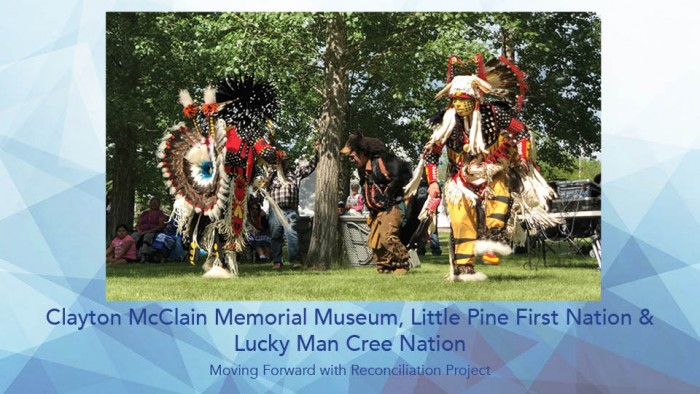
Recipients of the 2020 Museums Association of Saskatchewan Award of Merit for ‘Institution projects over $50,000’ were Clayton McClain Memorial Museum, Little Pine First Nation & Lucky Man Cree Nation for Moving Forward with Reconciliation.

award of merit for cmmm, little pine first nation, lucky man cree nation for moving forward with reconciliation project
Moving Forward with Reconciliation event, 2020

~ from the Nomination:

“The Clayton McLain Memorial Museum is a small-town museum located in Cut Knife Saskatchewan. The Museum is located on Treaty 6 Territory and has a rich history of partnership with surrounding Indigenous communities.

The summer of 2019 was a very busy summer for the Clayton McClain Museum. Thanks to a generous grant from the National Indian Brotherhood Trust Fund the museum was able to partner with Little Pine First Nation and Lucky Man Cree Nation on a three-part project called โ€œMoving Forward with Reconciliationโ€ that was initiated by Chief Wayne Semagnuis and councilor Richard Checkiosis of Little Pine First Nation.     

The first event was held on July 2, 2019 in Fort Walsh SK to recognize 140 years since Chief Minahequosis (Little Pine) and Chief Papaway (Lucky Man) were coerced into signing an adhesion to Treaty 6 because their people were suffering from forced starvation. This memorial event and was attended by over 550 people. It connected the attending members of Little Pine First Nation and Lucky Man Cree Nation to their ancestors and traditional territories by offering a feast and a mini pow wow in their honour. Jimmy Oโ€™Chiese of the Yellowhead Tribal College in Edmonton Alberta spoke and told the Cree Creation Story and how it is intimately linked to the Cypress Hills, as well as introducing the concept of land-based education for those in attendance.

The second part of the celebration took place in Cut Knife on July 5, 2019 and was attended by over 350 people. This event connected the local Indigenous people to the sacred artifacts that are held in trust in the collection of the Clayton McClain Memorial Museum. These items are normally kept separate from the rest of the collection in a secure area and are cared for by Elders through ceremony and protocol, but were brought out to be displayed for the day after the blessings and a smudging ceremony. This event also included a traditional feast and a much larger mini pow wow with dancers from Little Pine, Lucky Man, Sweetgrass and Saddle Lake. The feast and pow wow were used to honour the sacred items and the ancestors who used them in ceremonies. Another important part of the purpose of having the event in Cut Knife was also to educate people about the events that occurred 140 years ago.        

The third part of the event took place on September 9, 2019 at Fort Pitt and was attended by approximately 150 people. This conclusion to the celebrations connected the Indigenous people in attendance to Treaty 6 territory and the lands they ultimately came to reside upon.

This three-part celebration heralded many firsts for many of the people involved. Overall, it was an event that should be remembered as a step towards ongoing reconciliation โ€“ a journey where there is still much more work to be done.”