WHEN: Sunday, March 27, 2022 at 2:30pm. WHERE: In person at the Cut Knife Community Centre at 204 Otter Street or via Zoom (email cmmmcutknife@gmail.com for the link).
The Board meets once a month, usually in the evening on the 4th Friday. Meetings are held at the Museum Admin & Archives Centre (MAAC) at 201 Railway Avenue or, as has often been the case during Covid-19, via Zoom. There are a variety of Committees ranging from Finance to Acquisitions to Fundraising to Education and Public Outreach, and more. Something for everyone wherever your interest lie!
There are regular events in which the Board participates, like the pre-season walk-thru of the heritage village buildings to ensure all will be in shape to open to the public in the early summer. Board Trustee terms run for 2 years.
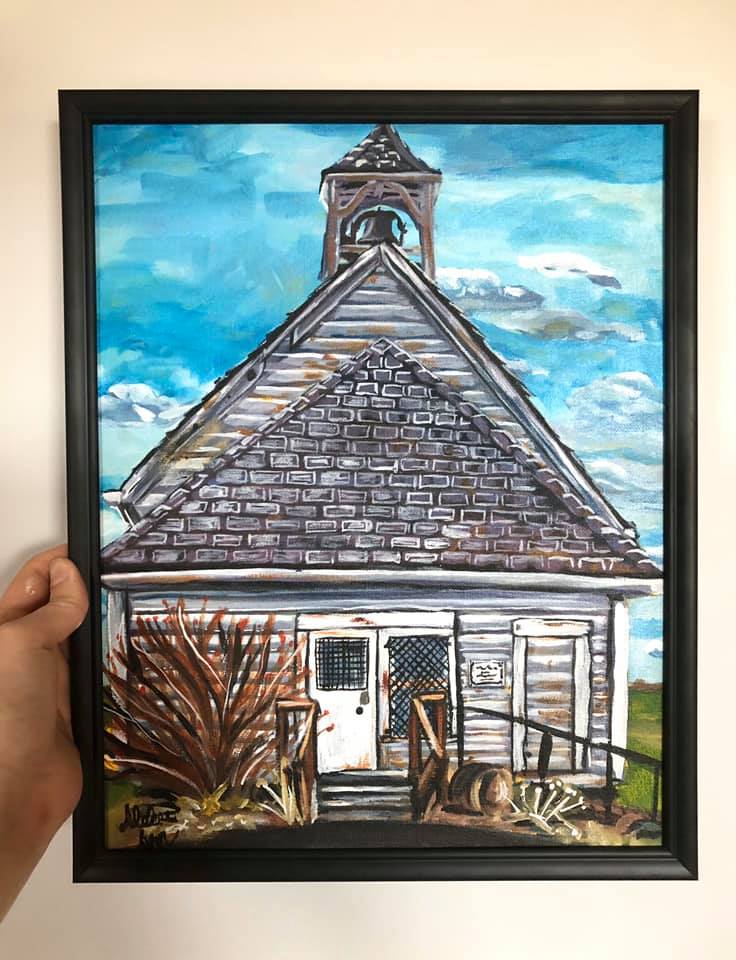
A beautiful capture of Ovenstown in the spring of 2020, especially poignant since it was demolished that fall. Aleksi Anseth grew up in Cut Knife and continues to live in the area. Take a look at her Facebook page (link below) for more wonderful examples of her talent.
This building has served many uses throughout its life, functioning as a church, one-room school, and eventually, a museum. I’ve spent a couple of my summers working at the museum, and got pretty cozy with Ovenstown specifically, as it was the museum office when I worked (that honour now belongs to the Duvall House!), so I’ve spent many hours in and around the building. Even with those hours logged with it, I still find the front of the building really visually striking. It has a presence that commands attention. Speaking purely on exterior design, Ovenstown is probably my favourite building at the museum! Acrylic on 11X14″ Canvas board
In June, the Clayton McLain Memorial Museum was one of five local organizations that received a $1000 donation from the Cut Knife Royal Purple. The museum is thankful for their recognition of our role in the community and very grateful for their support.
The other recipient organizations were the Cut Knife Municipal Library, the Cut Knife & District Recreation Board, Cut Knife Country Lanes, and the Cut Knife Senior Citizen Recreation Centre. All five organizations have been recognized as vital to the community.
Twila Loranger presented the cheques at the Innovation Credit Union on Broad Street.
Twila Loranger, Royal Purple, presenting Colton Stapley, President of the CMMM (and son) with cheque.
“The Cut Knife Royal Purple is a fun-loving, dynamic, dedicated, group of volunteers. We are proud to work towards helping children and our community.”
Cultures, political systems, religious persuasions and individual personalities have influenced the degree of peace that existed, here, between neighbours. Our museum would like to understand these events so that we may learn from the mistakes, celebrate the successes and promote understanding and acceptance. Just north of the Cut Knife town site, two historic battles took place:
BATTLE AT BROKEN KNIFE’S LOOKOUT
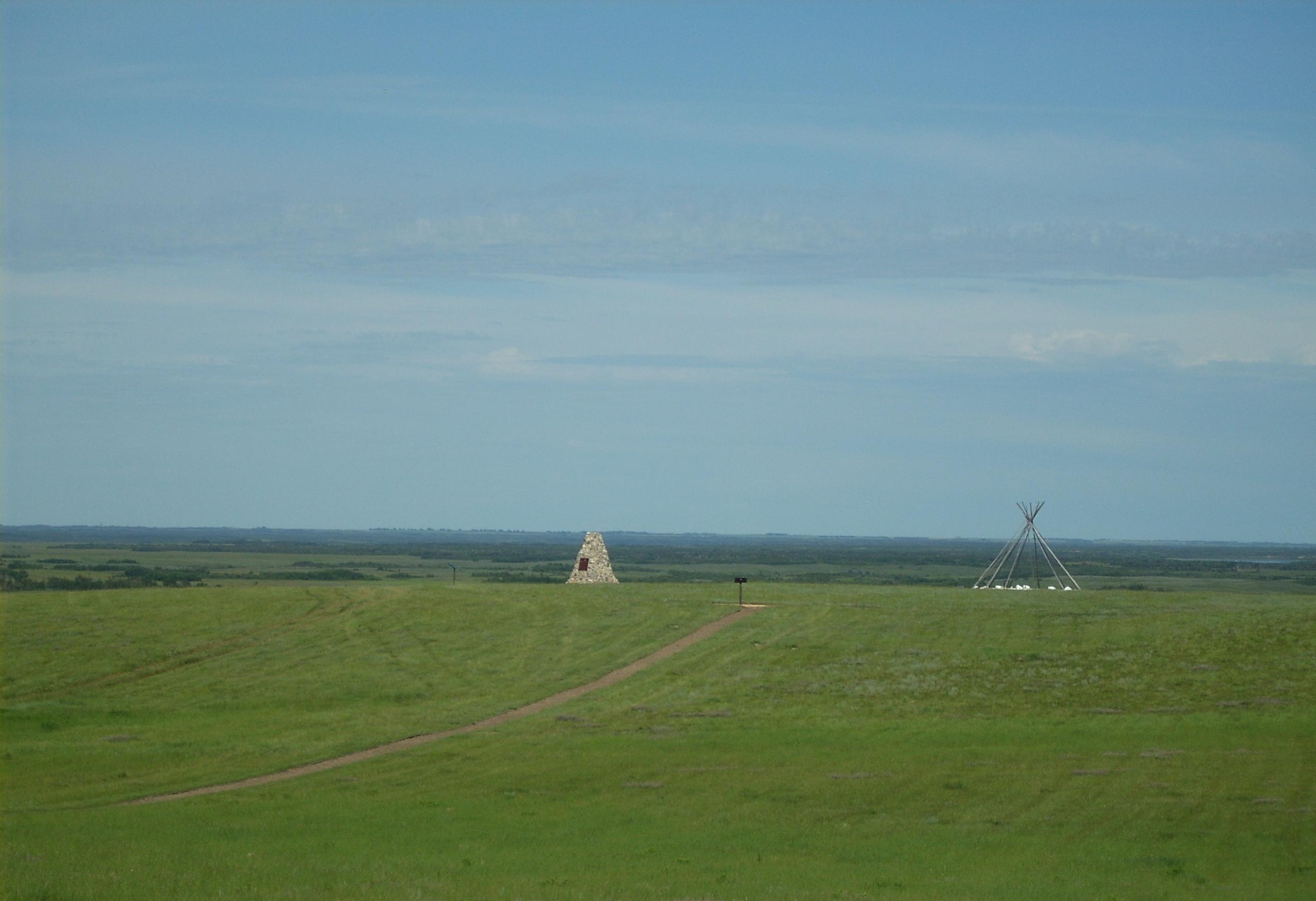
This battle was fought at the highest hill in the area, in the 1840s, between the Cree and the Tsuut’ina (formerly known as the Sarcee) from the Blackfoot Confederacy. The invading Tsuut’ina chief, Broken Knife (later loosely translated to Cut Knife), was defeated. But, the Cree had greatly appreciated his fighting ability and so named the hill after him to honour his skill. One of the Sarcee warriors escaped and returned to his home to tell the story.
Chief Poundmaker Historic Site
When the town forefathers were looking to name the settlement, they decided to use the name of the hill as it was a significant landmark to the north.
The 1885 Battle at Cut Knife Creek was one of a series of violent outbreaks which came to be known as the Northwest Resistance. Federal troops, under the command of Lieutenant-Colonel Otter, marched west from Fort Battleford to attack Pîhtokahanapiwiyin’s (Chief Poundmaker’s) camp at Cut Knife Creek. The militia was defeated by the Cree’s guerrilla tactics under the leadership of war chief Fine Day. The troops withdrew and were only saved from slaughter due to the intervention of Pîhtokahanapiwiyin.
This was the last defeat of government forces in the 1885 Resistance.
In the early 1900s, life on the prairies was harsh for all who lived here.
European settlers often came to their homesteads with very little material goods. Neighbours would band together to help one another with large projects, to socialize with each other to make life less lonely, and to work together to establish a community. Immigrants came from all across Europe, the United States and eastern Canada and many chose to settle near people of their own culture, such as the Italians who put down roots in the Baldwinton area.
The Cree, trying to adapt to reserve life in the post-1885 years, were also having a very difficult time. Restrictions placed upon reserve residents were harsh. Travel off the reserves and between the reserves was controlled by a government representative. Ensuring that everyone had enough to eat was a constant struggle. But, in this community, as well, neighbours helped one another, socialized together, and worked together to build their community.
Cultural differences, language barriers and government rules were felt by everyone living in the Cut Knife area.



 Clayton McLain Memorial Museum