Yesterday, Randy began installation of the track lighting. The smaller size of the room means lighting infrastructure can be minimal but it also has to be flexible to accommodate the full range of visual arts practices. LED track lighting has adjustable track heads that can be customized for each exhibit, and it’s easy to clean and maintain. As a non-profit, the CMMM also appreciates its energy and cost efficiency.
Left: Randy installing the track. Right: The first track head installed.
Once the lighting is functional, the next steps will be installation of the hanging system and then security.
Library’s Book Sale books are on their way out. The work table is set up for the upgrade to track lighting.
If you’ve read a few of these gallery posts, you’ll know we’ve been looking for individuals to help us form a “working group.” Well, we’re still looking, and it’s time to describe the help we need, so you’ll know if you’d like to join us.
This working group will not form a Board of Trustees or Directors. The term the Museum used at its formation was “Advisory Committee.” We anticipate this will be an informal group that comes together when there is work to be done.
We hope to be ready to open with the first exhibit in early May, which means there’s much to be done very soon.
Randy may need some help with renovations. If so, watch this space for an announcement.
The real work is going to be in the requests for submissions, in the selection and scheduling of exhibits, coordination with artists and creators, and probably a dozen other things we’ll discover once the gallery is open.
We’ve talked about each exhibit running for a few months, and exhibits scheduled well in advance i.e. 6 months to a year.
Experience is not required. A soft spot for the visual arts will never be turned away.
The gallery (as yet unnamed) will showcase and celebrate the wide variety of artistic traditions practiced in this area. We hope the working group will reflect the rich diversity of people who live here. We invite interested individuals from all communities, including newcomers, First Nations and Métis, new residents, expats from other provinces, and longtime area residents of all ages and backgrounds, to join us.
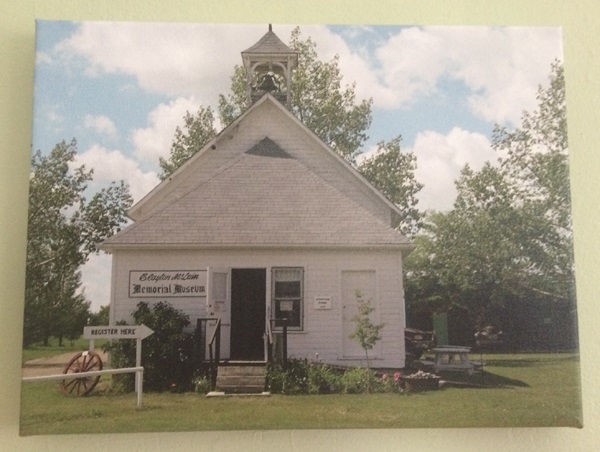
Ovenstown Registration circa 1971, canvas print hanging in the Duvall House
Back in the day, people carried cash or wrote cheques for admission to the CMMM. Donations, again, either by cash or cheque, were delivered in person or via Canada Post. There are many individuals who still carry cash and write cheques, but there are many, many others who don’t, and the Museum sees the difference.
Museum Admission
Admission is by donation and includes a guided tour of the Heritage buildings. Tours ensure the safety of visitors and the preservation of artefacts. Comments in the Visitors’ Book often express delight and appreciation for the tour, and for the guide who provided answers and shared additional anecdotes.
Visitors who arrive without cash in their pocket are still offered a tour. Some will make a quick trip to a cash machine and return momentarily. Others will leave with regrets. Those without cash-on-hand also miss the opportunity to purchase one of the local histories or gift items on display in the Duvall House.
Donations
The CMMM continues to receive annual contributions by cheque from long-time donors. Cash donations also come in at the Duvall House during Coffee Afternoons or with an Admission. All of these are put to good use: some on building repairs, some on exhibit maintenance; some on supplies i.e. printer ink, paper, laminating plastic, and so much more.
Alternatives to Cash & Cheques
Auto-deposit: This past fall, around the time of the Brick Fundraiser, the Museum enabled auto-deposit. No more security questions / answers required. It’s a relief for everyone. Use cmmmcutknife@gmail.com. One long-time donor used it recently for an annual contribution!
Canada Helps: This is a charity set up to facilitate online giving. Board members who have used it in the past recommend it as very user-friendly. To donate once, or monthly, click on the blue/green DONATE button on the Museum website to take you to the form, or visit our Canada Helps page here. Payment options are credit card, PayPal, or Google Pay. Canada Helps provides the tax receipt.
P.O.S. System (i.e. tap): We’ve done our research for internet service to the Duvall House and are eagerly awaiting its installation (date to be determined). It will enable a point-of-sale system to be available to visitors for admissions and / or donations. We’ll be announcing it’s arrival. Stay tuned!
As always, we are grateful for monetary donations of any amount but the community’s support also means so much i.e. attendance at events, word-of-mouth support to neighbours and friends, purchase of gift-shop items, sharing our posts on social media, and volunteering your time and energies to help with projects. Thank you!
Decision making began very early on in this process. In fact, probably about half way through the first meeting, we were trying to agree on the text for a Facebook post. That was after we’d settled on first steps, and after we’d selected Facebook for the group’s first public messaging. There we sat, stalled on the wording of the very first sentence.
Trying to craft a post about starting an art gallery in the front room at 113 Broad Street, we were divided on the term “art gallery”: “Elitist”, “not just paintings”, “hoity-toity”, etc. We soon agreed on “visual arts space”, a broad umbrella-like term that refers to a dozen different artistic practices:
The visual arts are art forms that create works that are primarily visual in nature, such as ceramics, drawing, painting, sculpture, printmaking, design, crafts, photography, video, film making and architecture… Also included within the visual arts are the applied arts such as industrial design, graphic design, fashion design, interior design and decorative art.
The gallery (as yet unnamed) will showcase and celebrate the wide variety of artistic traditions practiced in this area. We hope the working group will reflect the rich diversity of people who live here. We invite interested individuals from all communities, including newcomers, First Nations and Métis, new residents, expats from other provinces, and longtime area residents of all ages and backgrounds, to join us.
Do you have some free time and a soft spot for the visual arts? If so, help us establish this gallery space at 113 Broad Street for the artists and arts enthusiasts of Cut Knife and surrounding area. EmailRandyatcmmmcutknife@gmail.com. More: 1-The Spare Roomand 2-What Kind of Art Gallery?


 Clayton McLain Memorial Museum